|
|
|
|
|
|
|
|
|
|
|
|
|
|
|
|
|
Learn to Grow Native Plants with Winter Sowing!
Interested in growing native plants from seed this winter? This class is perfect for you! Buying native plants can be costly, even when your goal is to support native pollinators. That’s where winter sowing comes to the rescue—saving both your wallet and the environment.
Winter sowing is an easy, low-maintenance method to grow many native plants from seed at a fraction of the cost.
Join us on December 11th at the Alexander County Services Building for this hands-on workshop at 5:30 p.m. Participants will get to take home their own sown seeds.
Spaces are limited, so call our office to reserve your spot and pick your preferred session. Don’t miss this opportunity to grow your garden and your knowledge this winter!
|
|
|
|
|
|
|
Click on the following links to see the Garden Calendars for each month:
|
|
|
|
|
|
|
National Poinsettia Day
Each year on December 12th, the United States celebrates National Poinsettia Day in honor of Joel Roberts Poinsett, the nation’s first ambassador to Mexico and botanist who introduced this festive plant to the U.S.
Native to Mexico, poinsettias can grow 10–15 feet tall in their natural habitat as a deciduous to semi-evergreen shrub. They belong to the Euphorbiaceae family, many of which produce a milky white sap when damaged. While the sap may look unpleasant, it is not poisonous—just a bit messy!
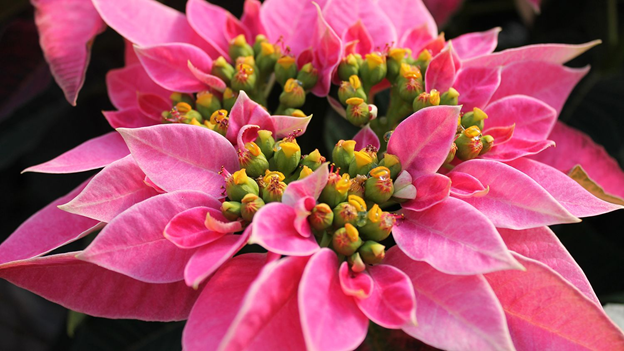
The vibrant “blooms” we associate with poinsettias are actually bracts, or modified leaves. The true flowers are the small, yellow structures nestled at the center of the bracts.
Poinsettias continue to be a holiday favorite—in fact, retail sales topped $215 million in 2019 according to the USDA National Agricultural Statistics Service.
Here in Alexander County, we’re fortunate to have several local options for purchasing poinsettias this Christmas season. Country Road Greenhouse and Carmen’s Greenhouse both grow poinsettias, and the Alexander County High School FFA program often produces plants as a fundraiser. When possible, please support our local growers!
If you’d like to learn more about poinsettias and the industry behind them, take a look at this article or feel free to reach out—I’m always happy to help.
Shop local, and we wish you a very Merry Christmas!
|
|
|
|
|
|
|
Holiday Houseplants and How to Care for Them!
Poinsettia
- Light & location: Poinsettias thrive in bright, indirect light, and should be placed away from cold drafts, heating vents, or fireplaces.
- Temperature: Ideal indoor temperatures are around 65–75 °F during the day; a slight drop at night (to ~60 °F) helps.
- Watering: Water when the top of the soil begins to dry; water thoroughly until drainage occurs, then let the plant drain before returning to decorative pots — avoid letting the plant sit in water or overly moist soil.
- After the holidays: While it's possible to keep a poinsettia alive, re-blooming is challenging; many people discard them after the holiday season if the bracts fade.
|
|
|
|
|
One of the new cultivars tested through the North American Poinsettia Trial at NC State. (NC State University)
|
|
|
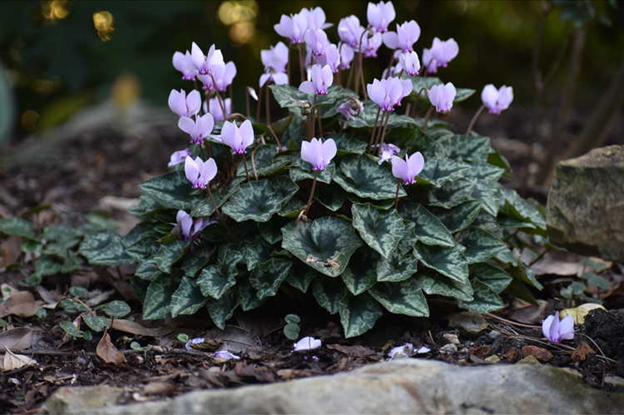
- Light & temperature: Cyclamen do best in bright, indirect light with cool indoor temperatures — roughly 50–60 °F at night helps prolong bloom and foliage.
- Watering: Keep the soil consistently moist but not soggy. Avoid watering directly over the crown (center) of the plant — instead water around the edges of the pot to prevent rot.
Maintenance after bloom: Remove faded flowers where they begin. When leaves fade, allow the plant to go dormant by gradually reducing water and placing the corm in a cool, dark, dry spot for 6–12 weeks. Later you can repot it so the top of the corm stays above soil, resume watering when new leaves appears, and fertilize monthly until buds form.
|
|
|
|
|
Christmas Cactus
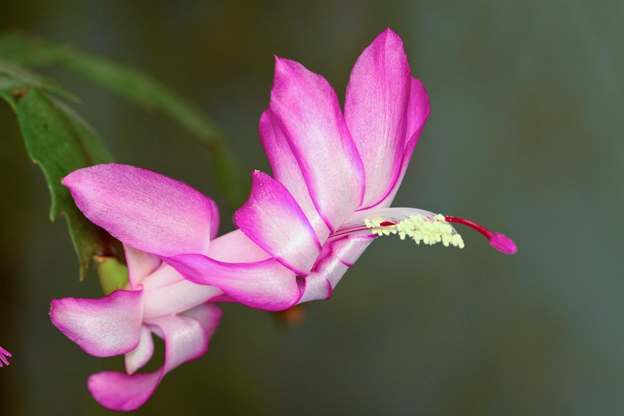
- Light & environment: Christmas cactus does well in bright, indirect light, and thrives at moderate, stable indoor temperatures (avoid hot, dry air or cold drafts).
- Watering: Water when the top inch of soil feels dry, but don’t let the soil stay soggy. Good drainage is essential to avoid root rot — water thoroughly and allow excess to drain out.
After bloom / long-term care: Christmas cactus is among the holiday houseplants most likely to survive and re-bloom in coming years with proper care.
|
|
|
|
|
|
|
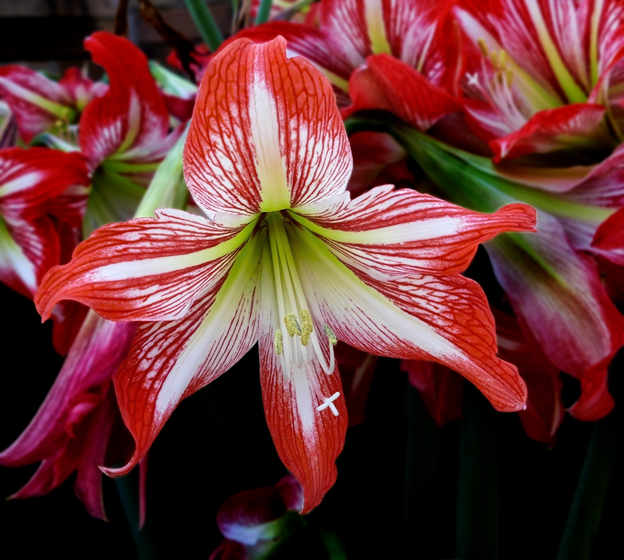
- Starting from bulb: Amaryllis are usually sold as bulbs rather than potted plants. Choose bulbs that are large, firm, and free of cuts or bruises for best results.
- Potting & planting: Use a pot just slightly larger than the bulb (so it’s slightly pot-bound), with good drainage. Place the bulb so about two-thirds are below soil, one-third above — burying too deep can cause rot.
- Light, temperature & watering: Once planted, set the bulb in bright light (but avoid harsh direct sunlight). Water just enough to keep soil moist until roots form, then water more regularly — ensuring drainage. During bloom, maintain moderate indoor temperatures.
- Post-bloom care: After flowering, cut back the flower stalk ~1–2 inches above the bulb “nose,” but keep the leaves — they rebuild bulb energy. Later, allow foliage to die back, reduce watering, and store the bulb in a cool, dry, dark place for 6–8 weeks. After that dormancy the bulb can be brought back to light and watered to trigger a new bloom cycle.
|
|
|
|
|
|
|
|
BOLOs (Be On The Lookout)....
|
|
|
Month-by-month lists of common plant diseases, pests, and other problems you may encounter in North Carolina yards and gardens. Straight from our PDIC (Plant Disease & Insect Clinic) entomologists and pathologists!
|
|
|
|
|
Save the Date! - Foothills Winter Landscapers Meeting 2026
Please save this date for this regional event designed for commercial landscapers and landscape contractors, offering landscape contractor credits, pesticide credits, & more! The all-day event will take place in Caldwell County at the Broyhill Civic Center on January 15, 2026. Please call our office for more information on how to register (828-632-4451).
|
|
|
|
|
|
|
|
2026 Brushy Mountain Tree Fruit Meeting
Welcome to our Regional Tree Fruit Meeting! This event is tailored for commercial tree fruit producers across the mountains, foothills, Brushy Mountain region, and Piedmont of North Carolina, as well as neighboring areas and states. Join us for an engaging day with specialists from NC State University, as we explore the latest research and management practices to enhance the success and sustainability of your orchards. Let's work together to tackle challenges, embrace innovations, and strengthen our tree fruit industry!
|
|
|
|
|
|
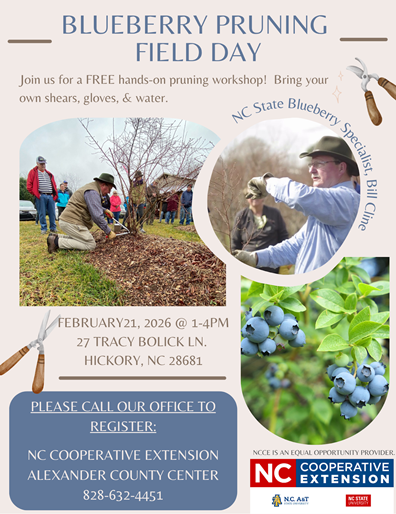
Blueberry Pruning Field Day 2026
NC Cooperative Extension-Alexander County Center is excited to announce the return of our annual Blueberry Pruning Field Day! This year, the event will be held on Saturday, February 21st, at Campbell's Berry Farm in Hickory, NC. We invite all blueberry enthusiasts to join us for this hands-on learning experience led by Dr. Bill Cline, NC State Blueberry Specialist. To participate, please call us at 828-632-4451 to register. Participants are encouraged to bring their own pruning shears, lopping shears, gloves, and water. Be sure to dress appropriately for the weather and the occasion.
Pruning is an essential practice for maintaining healthy, productive blueberry bushes. Regular pruning improves fruit size and taste, makes the plants easier to manage, and promotes new growth by replacing old, less productive canes. During the field day, you’ll learn expert techniques to optimize your harvest and ensure the long-term health of your blueberry plants. Don’t miss this opportunity to gain valuable knowledge and practical skills—come ready to learn and prune!
|
|
|
|
|
|
|
2026 Alexander Extension Small Fruit Plant Sale
It is time again to start ordering your fruit plants and trees! The N.C. Cooperative Extension - Alexander County Center is now taking orders and will until sold out. There are some new items this year as well as some we have offered previous years.
Please know that the earlier you place your order the better chance we will be able to complete your request. Plants will be available for pickup on March 5-6, 2026.
To check current availability or to place your order, please call our office at 828-632-4451 or email Cari Rosenbalm at cari_rosenbalm@ncsu.edu.
|
|
|
|
|
Alexander County offices will be closed the following dates:
Christmas:
December 24th, 25th and 26th
New Years Day: January 1st
|
|
|
|
|
|
|
|
|
NC State University and N.C. A&T State University work in tandem, along with federal, state and local governments, to form a strategic partnership called N.C. Cooperative Extension.
|
|
|
|
|
|
|