|
|
|
|
|
|
|
|
|
|
|
|
|
|
|
|
County Extension Director, Spring Williams-Byrd, will be retiring March 2026 after 37 years with N.C. Cooperative Extension.
She has served as 4-H Program Assistant, 4-H Extension Agent and the past 24 years as the County Extension Director in Burke County. Please join us as we celebrate Spring's career and offer congratulations and best wishes for a happy retirement on March 27th from 2:00-5:00pm.
For more information, call (828) 764-9480.
|
|
|
|
|
We want to hear from you!
The NC Cooperative Extension Burke Center is planning new Family & Consumer Sciences programs. Your input matters! Please take a few minutes to complete our short interest survey and let us know what topics you’d like to see offered. Or you can stop by our office and speak to Taylor Lynn, Family and Consumer Sciences Extension Agent.
Follow our survey link https://bit.ly/burkefcs or scan the QR code below to participate!
Your feedback will help shape future classes, programs, and workshops in our community.
|
|
|
|
|
|
|
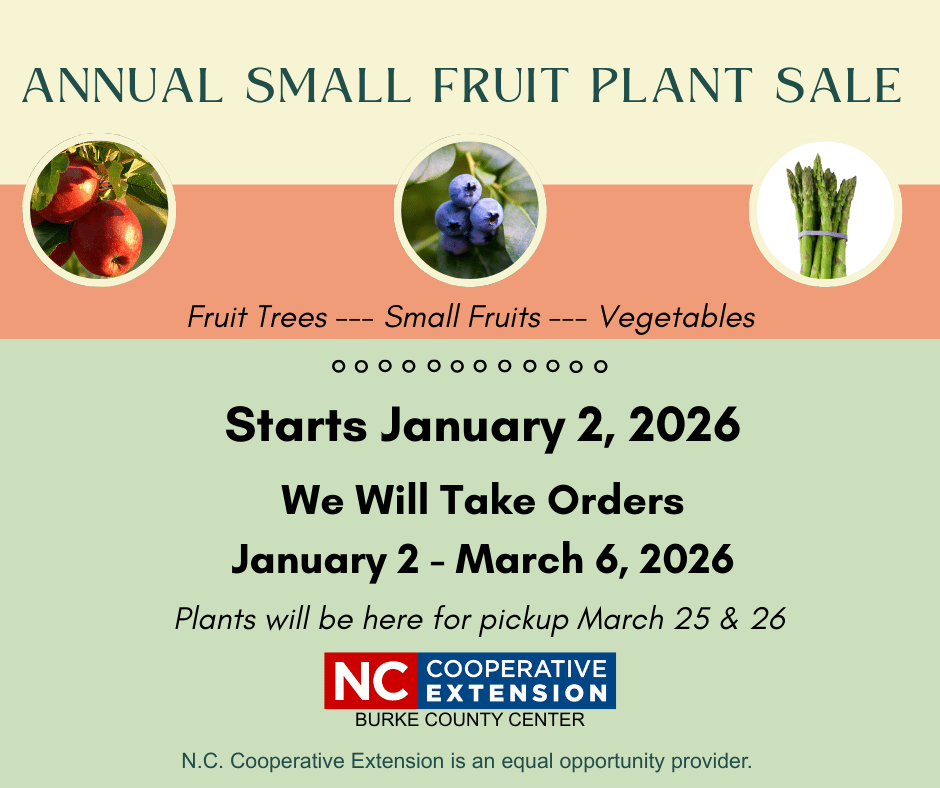
LAST Chance to order for 2026! Our Small Fruit Plant Sale ENDS March 6th.
Pick up days will be March 25th and 26th!
|
|
|
|
|
|
|
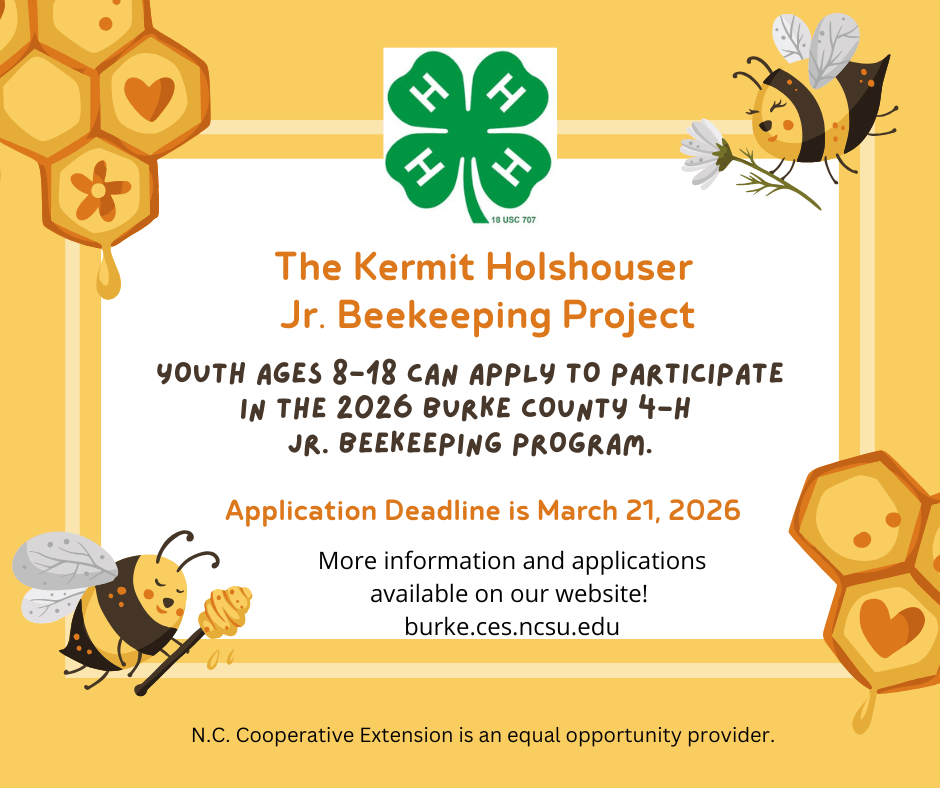
Are you ready to create a buzz?
Applications for the Kermit Holshouser 4-H Jr. Beekeeping Project are now available!
Where: Find them on our county Extension webpage or pick up a copy at our office.
Deadline: All applications are due by 5:00 PM on March 21, 2026.
Selection: Participants will be announced in early April.
|
|
|
|
|
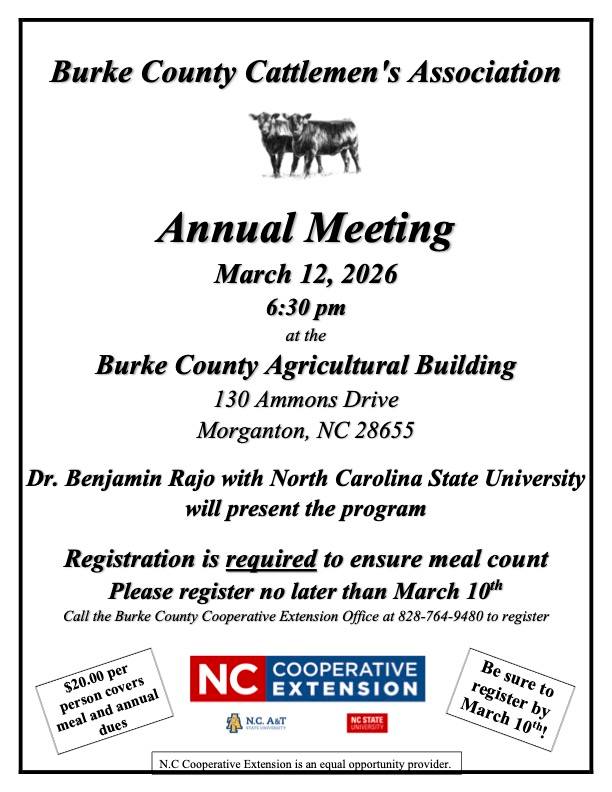
Burke County Cattlemen's Annual Meeting will be held March 12th.
Dr. Benjamin Rajo from North Carolina State University will present the program.
Call our office at 828-764-9480 to register
|
|
|
|
Early Spring Feeding the Beef Herd
Damon Pollard, Extension Agent, Livestock
Springtime is a nutritionally critical time for the beef herd. Most are giving birth, and their nutritional needs increase greatly prior to milk letdown, and several months post-partem. Rations fed to cattle during calving season should have enough energy and protein to allow proper calf development, milk production, and enable cows to maintain themselves through the stress of calving. Keep in mind, metabolic needs of cattle increase anytime that they must use energy to maintain body heat, such as cold winter and early spring nights. Rations of feed or grain as an energy source help to offset this rise in energy needs. Liquid or block protein supplements can aid in upping daily protein intake. By combining these two, with a good, to high quality hay ration, producers can enable their herds to withstand the rigors of spring. Pay particular attention to first calf heifers, and young cows, as they tend to be timid feeders, and the “boss” cows usually beat them away from the feed bunks.
By developing feeding plan that accounts for increased nutritional needs in early spring, producers can ensure that their herds will emerge from winter solstice fit enough to remain efficient, and productive, for the rest of the year.
|
|
|
|
|
|
|
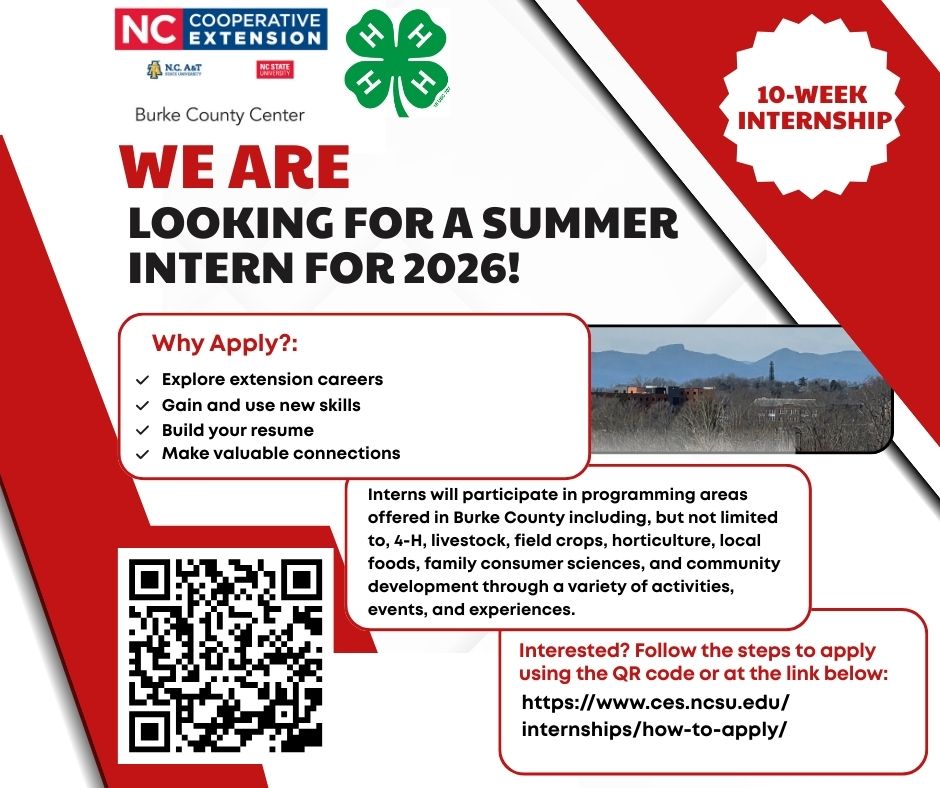
Join the Burke County team as an Extension Summer Intern!!
You will work with Extension personnel to deliver hands-on, educational programs. Job shadowing and mentoring help interns learn about the mission and work of North Carolina Cooperative Extension.
Deadline to apply is March 6, 2026.
To learn more go to: https://www.ces.ncsu.edu/internships/how-to-apply/
|
|
|
The Power of Potential
Nicki Carpenter, Extension Agent, 4-H Youth Development
What is 4-H? It’s more than a club—it’s a community of more than 100 public universities across the nation, delivered by Cooperative Extension, providing experiences where young people learn by doing. For more than 100 years, we havewelcomed youth of all beliefs and backgrounds.
We give kids a voice to express who they are and how they make their lives and communities better. Through life-changing programs, nearly six million kids and teens are learning the skills and abilities to be resilient, adaptable, and ready for work and life.
At 4-H, we believe in the potential of all young people. We believe in developingyouth who are empowered, confident, hard-working, and compassionate. We want our youth to see a world beyond themselves, gaining the life-long skills to succeed in both college and career. We believe every child is valuable and deserves the support and freedom to choose their own path.
By leveraging the power of America’s leading public universities, we practice positive youth development by creating positive learning experiences. We’re not just teaching skills; we’re building determined and responsible leaders.
Join us in empowering the next generation. Believe in the power of young people.
To find a 4-program near you, visit 4-H.org, or you can call our office at 828-764-9480.
|
|
|
|

MORE IN MY BASKET
Every year, many North Carolinians miss out on applying for benefits they may be eligible for. Others don’t know what kinds of programs are available for them. Here’s a quick list of options if you or someone you know needs assistance:
SNAP/FNS: Commonly known as Food Stamps, this program sends participants a certain amount of benefits to be used to buy food. Call the More In My Basket team for questions about SNAP at 1-855-240-1451.
Food Banks: To find food banks available in your area in North Carolina, visit: www.feedingthecarolinas.org/find-food/. All you need to do to find a list of food banks is select your zip code, city or address and select “Get Help.”
NC 211: This is a free and confidential referral service provided by United Way. You can contact them by calling 2-1-1 or 1-888-892-1162 or visiting their website at www.nc211.org
The More In My Basket website has tips on how to find other local resources for you and your family, and they can help you with any questions about SNAP that you may have. Visit morefood.org or call them at 1-855-240-1451.
|
|
|
|
|
|
|
You do NOT need to Register, but you must bring your license to scan for
these Pesticide Recertification Classes.
|
|
|
Buttercup Control
Damon Pollard, Livestock Extension Agent
Buttercups are a problem in cool-season grass pastures, and are easily recognized in early spring by their bright yellow flowers. Buttercups possess several weedy characteristics that make it difficult to control in pastures. Populations are usually greater in low areas of fields that tend to remain wet for long periods, and in pastures with poor stands of grass. Overgrazing usually increases the buttercup populations. There are many species of buttercups, each with different characteristics. The bulbous and small flower buttercups tend to be more common in pastures. Pasture management techniques promoting the growth of pasture grasses will provide competition and inhibit the growth of buttercups. These practices include proper soil fertility and pH, avoidance of overgrazing, timely mowing and herbicide treatments. It is important to treat buttercups with herbicides before flowering, as treatments after flowering require higher rates and will not prevent seed formation. 2-4-D ester formulations @ 1-2 quarts/acre provided 100% control in one University of Kentucky study, so costs can be kept to a minimum in properly timed. Weedmaster at 3 pints/acre also provided 100% control, as did Crossbow @ 2-3 quarts/acre. With perennial weeds such as buttercups, there are many factors involved with herbicide control because of species variety, so control may involve several seasons.
|
|
|
|
|
|
|
We are Hiring!!
N.C. Cooperative Extension, Burke County Center is seeking a dedicated and organized Administrative Assistant to join our team.
The admin. assistant will provide crucial support to our office operations, ensuring smooth administrative processes and efficient communication.
To see requirements, responsibilities, and to apply go to:
|
|
|
|
|
|
Burke County Beekeepers Association
Beekeepers Monthly Meeting
March10, 2026
7:00 pm
Burke County Agricultural Building
130 Ammons Dr.
Morganton, NC 28655
|
|
|
|
|
Growing Together: Head, Heart, Hands, and Health!
Nicki Carpenter, Extension Agent, 4-H Youth Development
Spring is just around the corner, and our 4-H calendar is blooming with new opportunities! Whether you're a teen looking for leadership skills, a parent wanting to
get involved, or a future beekeeper, there is a place for you here. Let’s make the best better this month!
Upcoming Club Meetings & Workshops
All meetings held at 5:30 PM. Call 828-764-9480 to let us know you’re coming!
4-H Teen Leadership (March 9th): Open to ANY Burke County youth ages 12-
18! Come for hands-on learning about "adulting 101," career readiness, and
stress management. Bring a friend!
4-H Foundations (March 16th): Calling all parents, caregivers, and volunteers!
Learn how to support our youth and discover multi-level leadership opportunities
from the county to the national level.
First Steps 4-H Club (March 19th): New to 4-H? This agent-led club
demonstrates 4-H structures through hands-on activities. Open to all families;
youth must be accompanied by an adult.
|
|
|
|
|
|
|
|
4-H Summer Camp: Eastern Center
Get ready for a 5-night adventure at the Eastern 4-H Conference Center in Columbia,
NC, from June 14-19! For Ages: 9–14. Cost: $550 (Scholarship applications are available!). Activities include: Coastal ecology, shooting sports, kayaking, and offsite camping for older youth. Spaces are limited, so contact Nicki soon to get on the list!
|
|
|
|
|
|
|
|
|
|
|
|
|
|
NC State University and N.C. A&T State University works in tandem, along with federal, state and local governments, to form a strategic partnership called N.C. Cooperative Extension.
|
|
|
|
N.C. Cooperative Extension is an equal opportunity provider.
|
|
|
|
|
|
|
|
|
|
|
|
|