|
DELIVERING EDUCATION AND TECHNOLOGY THAT ENRICHES THE LIVES, LAND, AND ECONOMY OF NORTH CAROLINIANS
48
December 2025 |
|
|
|
|
Comparison of Heat Lamps and Heat Mats |
|
|
|
Suzanne Leonard, Isaac Suazo, Eduardo Beltranena, Cristhian Valladares Paz
Department of Animal Science, NC State University
|
 |
|
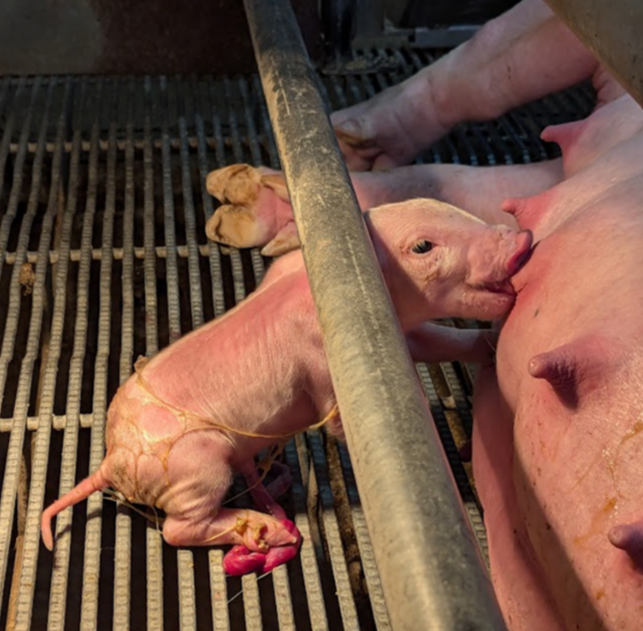
A warm, dry, draft-free microclimate area is critical for piglet success in farrowing barns. Providing a comfortable creep area can encourage piglets to lay away from the sow, reducing the risk of injury or crushing. Approximately 0.5 ft2 creep area per piglet is recommended. Heating a portion of the creep area can create a warmer microclimate for the piglets. The microclimate can better meet the needs of young piglets, as they do not have much body fat and are poor thermoregulators. A proper microclimate can help piglets stay warmer, allowing the piglets to divert more energy on growth and development instead of keeping warm. Ideally, the heated microclimate area should be 90 – 95 °F, but a wider range of 86 – 110 °F is tolerable for most piglets (Stinn & Xin, 2014). The thermal status of the piglet can be influenced by flooring type, air current drafts, and moisture, highlighting the importance of keeping the creep area dry, draft-free, and clean. Having a warmer microclimate area specifically for piglets also allows for the farrowing room temperature to be reduced, making it a more comfortable and productive environment for the sow. Overheating the farrowing room for the sows reduces their feed intake, thus affecting their milking ability.
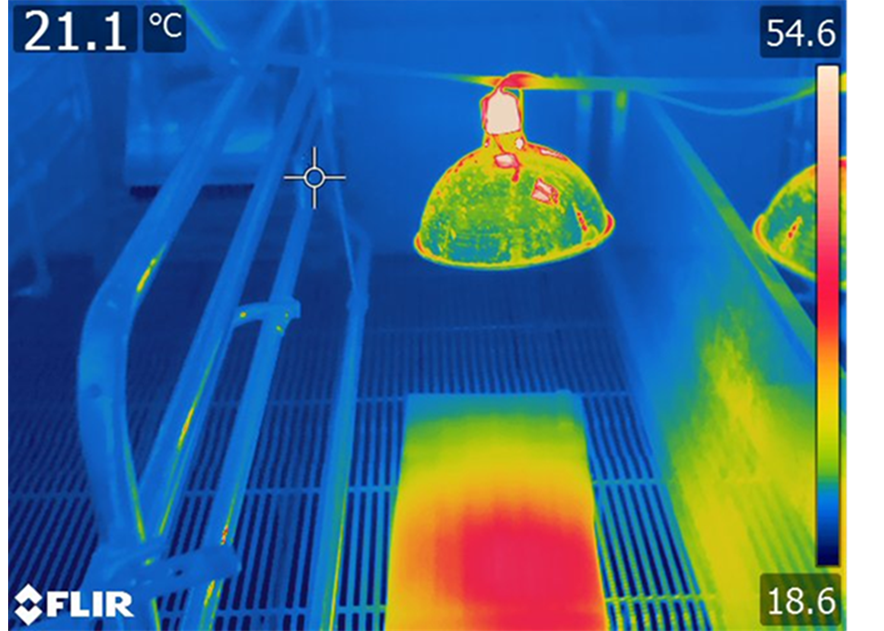
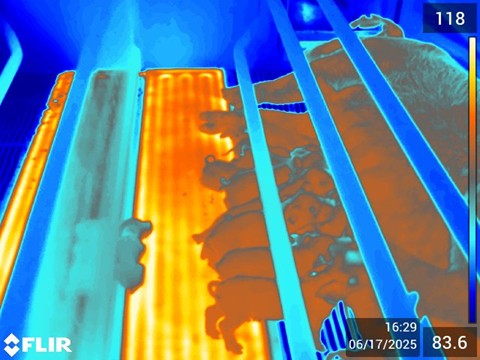
There are various types of commercially available microclimate heat sources with the most popular types being heat lamps, heat mats, and hovers or enclosures. Enclosures maximize heat retention in the microclimate area but can create challenges with visual inspection of the piglets and cleaning. Heat lamps are the traditional microclimate choice but can inadvertently heat the sow if mounted too high or too close in narrow creep areas. Further, bulbs provide a variably heated area, with the parts directly under the lamp being warmest (Figure 1). Heated mats can provide a more uniformly heated area and require approximately 36% less electricity usage (Figure 2; Stinn & Xin, 2014).
|
 |
|
|
|
|
Figure 1. Thermal image of a heat lamp in a farrowing stall. Values are in degrees Celsius. |
 |
|
Figure 2. Thermal image of a HogHearth piglet mat in a farrowing stall. Values are in degrees Fahrenheit.
We compared the functionality of heated mats versus heat lamps in a trial conducted at the NCDA Tidewater Research Station. Fifty-four multiparous sows were allotted to farrowing stalls equipped with either a Mat (n = 24) or a Lamp (n = 30). Piglets were crossfostered to balance litter size, weighed at birth and weaning, and weaned at approximately 28 d of age. Number of pigs weaned, litter weight gain, and piglet survivability were compared using t-tests adjusted for multiple comparisons. No differences were found in number of pigs to raise, number weaned, litter average daily weight gain, or prewean mortality (p > 0.1; Table 1). These results agree with published literature, as Besheda et al. (2006), Stinn & Xin (2014), and Lane et al. (2020) also reported no piglet productivity differences between providing heat mats and heat lamps.
Table 1. Productivity metrics compared litters provided heat lamps vs. heat mats. No statistical differences were found. Values represent average ± standard error. |
 |
|
Special thanks to Steve Stitzlein, Chris Grant, and iHT Group for the donation of the heat mats and controllers used in this study.
Sources:
Stinn JP, & Xin H. 2014. Heat lamp vs heat mat as localized heat source in swine farrowing crate. Iowa State University Animal Industry Report, AS Leaflet R2931.
Lane KJ, Johnson AK, Stilwill CEJ, Karriker LA, Harmon JD, Stalder KJ. 2020. Comparison of heat lamps and heat mats in the farrowing house: effect on piglet production, energy use, and piglet and osw behavior through live observation. Journal of Swine Health and Production, 28(4): 205-212.
Beshada E, Zhang Q, Boris R. 2006. A cost effective heating method of piglets in swine farrowing barns. CSBE/SCGAB 2006 Annual Conference. Paper No. 06-224.
|
|
|
|
|
Comparación entre lámparas de calor y tapetes térmicos en el desempeño de lechones lactantes |
|
|
|
Suzanne Leonard, Isaac Suazo, Eduardo Beltranena, Cristhian Valladares Paz
Universidad de Carolina del Norte, Raleigh, NC
|
|
|
Un microclima caliente, seco y libre de corrientes de aire es importante para la sobrevivencia y el crecimiento de lechones en salas de maternidad. Proporcionando un área de resguardo cómoda puede incentivar a los lechones a acostarse lejos de la cerda, reduciendo así el riesgo de aplastamiento o de lesiones por la cerda. Se recomienda aproximadamente 0.5 pies² (0.046 m²) de área de resguardo por lechón. Calentando solamente una parte del corral puede crear un microclima adecuado para los lechones. El microclima puede satisfacer mejor las necesidades de los lechones jóvenes, ya que estos no tienen mucha grasa corporal y por eso tienen dificultad regulando su temperatura.
Un microclima adecuado en el corral puede ayudar a que los lechones destinen más energía a su crecimiento y desarrollo en lugar de al mantenimiento de su temperatura corporal. Idealmente, el área de microclima debe mantenerse entre 90 y 95 °F (32.2 a 35.0 °C), aunque un rango más amplio de 86 a 110 °F (30.0–43.3 °C) es tolerable para la mayoría de los lechones (Stinn & Xin, 2014). La condición térmica del lechón puede verse influida por el tipo de piso, las corrientes de aire y la humedad, lo que resalta la importancia de mantener el área de resguardo seca, limpia y sin corrientes de aire. Un área de microclima para lechones en corrales de lactancia permite reducir la temperatura de la sala de maternidad, creando un ambiente general más cómodo y productivo para la cerda. Si la sala de maternidad se sobre calienta, las cerdas reducen su consumo de alimento y, por tanto, esto afecta su capacidad de producir leche y amamantar a la camada.
Existen varios tipos de fuentes de calor para microclimas disponibles comercialmente siendo los más comunes las lámparas de calor, tapetes térmicos, cobertores o encierros. Los encierros maximizan la retención de calor en el área de microclima, pero pueden dificultar la inspección visual de los lechones y la limpieza de esta área. Las lámparas de calor son la opción tradicional para microclimas, pero pueden calentar inadvertidamente a la cerda si se colocan demasiado altas o cerca a la cerda en áreas de resguardo estrechas. Además, las bombillas generan un área calentada de forma variable, siendo las zonas directamente debajo de la lámpara las más calientes (Figura 1). Como alternativa, los tapetes térmicos pueden proporcionar un área calentada de manera más uniforme y requieren aproximadamente 36% menos consumo de electricidad (Figura 2; Stinn & Xin, 2014).
|
|
|
|
|
|
Figura 1. Imagen térmica de una lámpara de calor en una jaula de maternidad. Las temperaturas mostradas están en grados Celsius. |
|
|
Figura 2. Imagen térmica de un tapete térmico para lechones HogHearth en un corral de maternidad. Las temperaturas mostradas están en grados Fahrenheit.
Nosotros comparamos la funcionalidad de los tapetes térmicos contra las lámparas de calor en una prueba llevada a cabo en la Estación de Investigación de Tidewater, Departamento de Agricultura de Carolina del Norte, Plymouth, NC. Cincuenta y cuatro cerdas multíparas fueron asignadas a jaulas/corrales de maternidad equipados ya sea con un tapete térmico (n = 24) o una lámpara de calor (n = 30). Los lechones fueron redistribuidos para equilibrar el tamaño de las camadas, y fueron pesados al nacimiento y al destete a aproximadamente los 28 días de edad. Nuestros resultados indican que no hubo diferencias en el número de lechones criados, número destetado, ganancia diaria promedio de peso de la camada, ni mortalidad pre-destete (P > 0.1; Tabla 1). Estos resultados coinciden con la literatura publicada, ya que Besheda et al. (2006), Stinn & Xin (2014) y Lane et al. (2020) también reportaron que no hubo diferencias en la productividad de los lechones comparando el uso de tapetes térmicos vs. lámparas de calor.
Tabla 1. Métricas de productividad comparando camadas provistas con lámparas de calor vs. tapetes térmicos. Los valores representan el promedio ± error estándar.
|
 |
|
Nuestro agradecimiento a Steve Stitzlein, Chris Grant y el Groupo iHT por donar los tapetes térmicos y sus controladores utilizados en este estudio.
Referencias:
Stinn JP, & Xin H. 2014. Heat lamp vs heat mat as localized heat source in swine farrowing crate. Iowa State University Animal Industry Report, AS Leaflet R2931.
Lane KJ, Johnson AK, Stilwill CEJ, Karriker LA, Harmon JD, Stalder KJ. 2020. Comparison of heat lamps and heat mats in the farrowing house: effect on piglet production, energy use, and piglet and osw behavior through live observation. Journal of Swine Health and Production, 28(4): 205-212.
Beshada E, Zhang Q, Boris R. 2006. A cost effective heating method of piglets in swine farrowing barns. CSBE/SCGAB 2006 Annual Conference. Paper No. 06-224.
|
|
|
|
|
If you did not receive this newsletter directly in your inbox and would like to in the future, please join our mailing list by completing this form |
|
|
|
Stay Connected |
|
|
|
To stop receiving our promotional email, unsubscribe now
NC State College of Agriculture and Life Sciences
Campus Box 7601
NC State University Campus
Raleigh, NC 27695-7601
United States |
|
|
|
|