|
DELIVERING EDUCATION AND TECHNOLOGY THAT ENRICHES THE LIVES, LAND, AND ECONOMY OF NORTH CAROLINIANS
35
November 2024 |
|
|
|
|
|
|
Maternal Sow Dietary Requirements and Performance |
|
|
|
|
Should You Still Feed
Lactating Sows by Hand?
|
|
|
|
|
|
Are Current Dietary Requirements Sufficient to Support the Advancing Reproductive Needs of Highly Prolific Modern Sows? |
|
|
|
Alexa Gormley, Ki Beom Jang, Yesid Garavito-Duarte, Zixiao Deng, and Sung Woo Kim
Department of Animal Science, North Carolina State University |
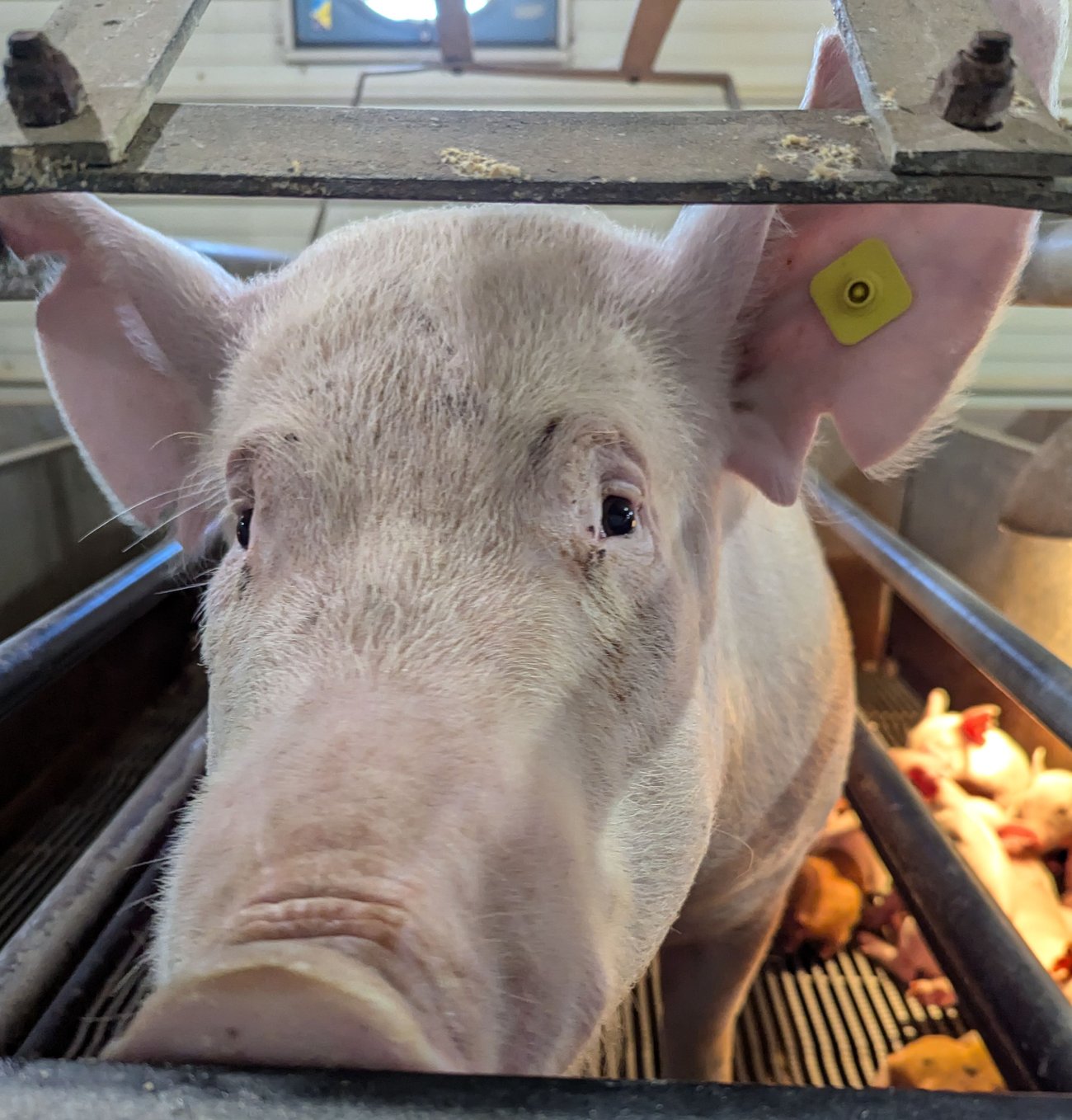 |
|
The last several decades have brought immense changes to the productivity of modern sows due to improvements in genetics [1]. Among these improvements, litter size has increased at a rate of approximately 0.20 pigs per year over the last 20 years, which leads to an increased need for milk production in response. As such, there are concerns that the nutrient demands on the sow may be much greater than in the past, therefore, current feeding programs may be limiting in certain nutrients, specifically amino acids [2]. Considering that the most recent publication of the Nutrient Requirements of Swine (NRC) [3] was published in 2012, it can be assumed that those recommendations are below the actual requirements of modern sows. If highly prolific modern sows are not properly supported through the dietary composition, the sow will utilize her own maternal body stores to support the growth of her litter [4], which could cause negative physiological effects that can impact the health and growth of the litter [5], and limit future reproductive performance and longevity of the sow [6]. As such, the objective of this review was to investigate the amino acid requirements of the highly prolific modern sows and identify physiological challenges that could potentially be mitigated using select dietary interventions.
As litter size and piglet birthweight increase, amino acid requirements during gestation will simultaneously increase. The amino acid needs of a sow during late gestation are primarily required for fetal growth, mammary tissue growth, and colostrum production, with the rest going towards sow maintenance and uterine development [7]. Kim et al. [8] determined the deposition of amino acids in fetal and mammary tissue throughout different timepoints of gestation. To estimate the change in amino acids during gestation related to increased litter size and birthweight, data from this paper were used to estimate the change in amino acid requirements since publication of the most recent NRC [3]. In 2022, the Pig Improvement Company (PIC) reported that piglet birthweight on their elite farms had increased by approximately 0.22 kg per piglet from 2012 to 2022 [9]. This increase in birthweight combined with the previously discussed litter size data from PigCHAMP [10], was used to estimate the increase in amino acid requirements per day, in early and late gestation.
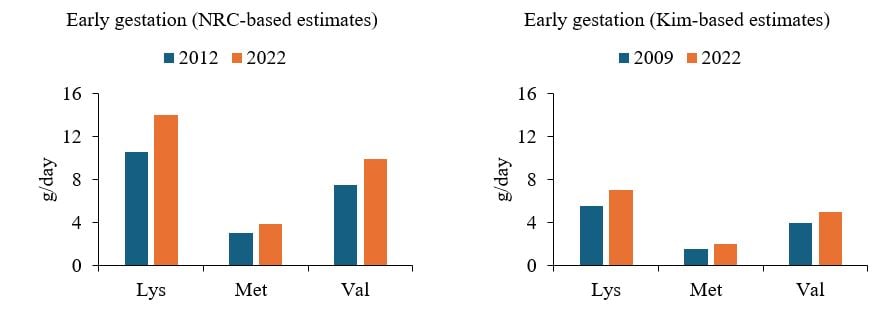
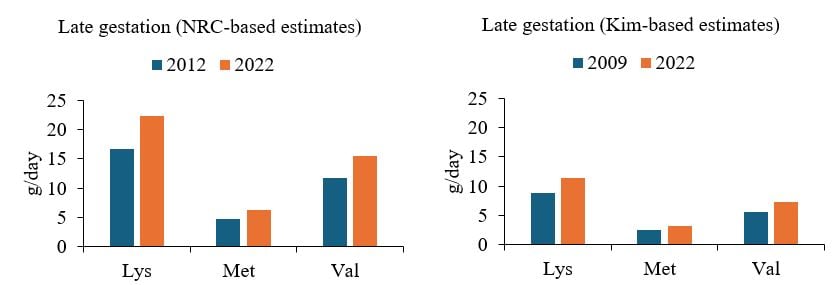
Two estimates were created (Figures 1 and 2), using the maintenance values for lysine provided by Kim et al. [8] for all estimates. Using data related to the average lysine gain per day per fetus [11], a ratio was generated to account for the increased litter size and individual piglet weight, by year. The Kim-based estimate utilized the analyzed values provided in the literature [8], whereas the NRC-based estimate utilized the recommendations generated based on the review of cited literature [3]. Two different estimates were created to account for the difference in the initial amino acid recommendations from both sources. The result reveals an estimated 31% (NRC-based estimates) and 26% (Kim-based estimates) increase in grams per day of lysine during early gestation (0 to 70 days gestation), and an estimated 33% (NRC-based estimates) and 29% (Kim-based estimates) increase in grams per day of lysine during late gestation (70 days gestation to farrowing), when compared with the current NRC feeding program, respectively.
|
 |
|
Figure 1. Change in lysine (Lys), methionine (Met), and valine (Val) as dictated by increasing litter size (weight and number of fetuses) as calculated according to the NRC model [3] and data from Kim et al. [8], for early gestation (approximately 0 to 70 days gestation). Figure accessed from: [12]. |
 |
|
Figure 2. Change in lysine (Lys), methionine (Met), and valine (Val) as dictated by increasing litter size (weight and number of fetuses) as calculated according to the NRC model [3] and data from Kim et al. [8], for early gestation (approximately 70 days gestation to farrowing). Figure accessed from: [12]. |
|
The physical challenges faced by modern sows due to their increased reproductive performance can cause adverse physiological effects like oxidative stress and general inflammation, increase incidence of prolapse and lameness, and decrease the quantity and/or quality of sow colostrum and milk [6]. To manage some of these physiological effects that may be unavoidable due to the burden of increased reproductive performance, the use of select dietary interventions have been investigated with success in improving sow and piglet outcomes. Some of the dietary interventions include but are not limited to, enzymes, organic minerals, single-cell organisms, and plant oils and extracts. A summary of the adverse physiological effects brought on by increased reproductive performance and the related research regarding opportunities for the use of select dietary interventions can be found in the full publication.
The rapid genetic improvements to reproductive performance in modern sows have led to nutritional challenges. In particular, the increased nutrient requirements of modern sows may not be reflected in current feeding programs, indicating that sows may utilize their own body stores to support the growth of the litter and colostrum and milk production. Similarly, the use of select dietary interventions can possibly improve reproductive performance and enhance the growth and health of suckling piglets. The use of additional mineral supplementation, enzymes, algae and yeast-based derivatives, and fiber sources and probiotics all have the potential to reduce the impact of adverse physiological effects caused by increased reproductive performance. In conclusion, thoughtful nutritional management strategies are crucial to address these concerns and ensure the well-being and performance of both sows and piglets.
References
1. Shen, Y.B.; Crenshaw, J.D. Physiological Changes in Sows That May Contribute to Higher Risk for Mortality and Prolapse. J. Vet. Sci. 2022, 6, doi: 10.4172/2581-3897.6.S3.001.
2. Wientjes, J.G.M.; Soede, N.M.; Knol, E.F.; van den Brand, H.; Kemp, B. Piglet Birth Weight and Litter Uniformity: Effects of Weaning-to-Pregnancy Interval and Body Condition Changes in Sows of Different Parities and Crossbred Lines1. J. Anim. Sci. 2013, 91, 2099–2107, doi:10.2527/jas.2012-5659.
3. NRC Nutrient Requirements of Swine. 11th Rev. Ed. Washington (DC): National Academies Press.; 2012; ISBN 978-0-309-22423-9.
4. Kim, S.W.; Easter, R.A. Nutrient Mobilization from Body Tissues as Influenced by Litter Size in Lactating Sows. J. Anim. Sci. 2001, 79, 2179, doi:10.2527/2001.7982179x.
5. Black, J.L.; Mullan, B.P.; Lorschy, M.L.; Giles, L.R. Lactation in the Sow during Heat Stress. Livest. Prod. Sci. 1993, 35, 153–170, doi:10.1016/0301-6226(93)90188-N.
6. Stalder, K.J.; Lacy, C.; Cross, T.L.; Conatser, G.. Financial Impact of Average Parity of Culled Females in a Breed-to-Wean Swine Operation Using Replacement Gilt Net Present Value Analysis. J. Swine Heal. Prod. 2003, 11, 69–74, doi: 10.54846/jshap/357.
7. Feyera, T.; Theil, P.K. Energy and Lysine Requirements and Balances of Sows during Transition and Lactation: A Factorial Approach. Livest. Sci. 2017, 201, 50–57, doi:10.1016/j.livsci.2017.05.001.
8. Kim, S.W.; Hurley, W.L.; Wu, G.; Ji, F. Ideal Amino Acid Balance for Sows during Gestation and Lactation. J. Anim. Sci. 2009, 87, E123–E132, doi:10.2527/jas.2008-1452.
9. The PIC Camborough Available online: https://www.pic.com/products/camborough/ (accessed on 17 March 2024).
10. Benchmarking Available online: https://www.pigchamp.com/benchmarking (accessed on 5 February 2024).
11. Kim, S.; Wu, G.; Baker, D.H. Ideal Protein and Dietary Amino Acid Requirements for Gestating and Lactating Sows. Pig News Inf. 2005, 26, 89–99.
12. Gormley, A.; Jang, K.B.; Garavito-Duarte, Y.; Deng, Z.; Kim, S.W. Impacts of Maternal Nutrition on Sow Performance and Potential Positive Effects on Piglet Performance. Animals 2024, 14, 1858, doi:10.3390/ani14131858. |
|
|
|
|
Should You Still Feed Lactating Sows by Hand? |
|
Eduardo Beltranena
Animal Science Department, North Carolina State University
During a recent meeting, someone asked, “Should you still feed lactating sows by hand?” My initial reaction was, “No! Why stick with the old methods?” But then I reconsidered and gave a more cautious answer: “Well, it depends.” Feeding lactating sows depends on multiple factors, including sow parity, week in the farrowing room, diet form, feeding behavior, and more. However, the biggies are feeder type, feed quantity, and location of the water source.
In a recent experiment with lactating sows in an old facility equipped with traditional bowl feeders, I saw firsthand the amount of labor involved in hand feeding. Feeding three times a day wasn’t feasible as staff were already stretched thin. When fed twice daily, the feeders couldn’t hold more than 7 pounds, making it hard to achieve high feed intakes. Generally, the more the sow eats in lactation the less weight she loses, the sooner she rebreeds, and the larger her litter size at the next parity. Sows were often so hungry shortly before feeding time that a portion of feed scooped onto them, fell on the sow snout, and she scattered it all over. Some sows nicked named “crazy eaters,” would eat with their head up tossing feed around or root feed out of the feeder bowl, and waste even more. Others would fill their feeder bowl with water, leading staff to feed them less to avoid wasting floating feed or having to return later to clean out uneaten waterlogged feed. This feed wastage cycle would repeat, adding to labor and increasing feed costs.
Lactating sow feeder technology has advanced considerably, and you don’t necessarily need state-of-the-art computerized feeders. Even a simple fixed PVC pipe ending inches above the trough, filled from a hopper or an auger, can progressively supply smaller amounts by gravity and greatly reduce feed wastage. Shelf feeders allow feed to flow in small amounts onto a dry shelf that the sow reaches and drops into the wet/dry trough or are equipped with a sow-activated lever. Wet/dry feeders help sows eat more and more quickly, reducing dry feed spillage. Computerized feeders can maximize feed intake by delivering large meals at specific times like early AM and late PM, plus small "teaser" meals throughout the day or when a sow triggers a switch. These feeders also alert staff if a sow isn’t eating. If you’re considering retrofitting or building a new barn, researching new technologies is well worth time and money, as reducing feed wastage and labor costs can free up resources for other tasks.
My takeaway is that producers should focus on feeder management rather than hand feeding sows. Equipment can undoubtedly deliver feed, but only people can observe, judge and adjust for each sow’s needs. Troubleshooting feeders yields the greatest returns on labor investment. Let equipment handle the feeding; human oversight is best used in managing the feeders and ensuring each sow's well-being. |
|
¿Deberías Seguir Alimentando Manualmente a las Cerdas Lactantes? |
|
Eduardo Beltranena
Animal Science Department, North Carolina State University
Durante una reunión reciente, alguien preguntó: "¿Deberíamos seguir alimentando manualmente a las cerdas lactantes?" Mi reacción inicial fue responder: “¡No! ¿Por qué seguir practicando métodos antiguos?” Luego reconsideré y di una respuesta más cautelosa: “Bueno, …tal vez”. La alimentación de las cerdas lactantes depende de múltiples factores, incluyendo la paridad de la cerda, la semana de estancia en la sala de maternidad, la forma de la dieta, el comportamiento de la cerda durante la alimentación, y más. Sin embargo, los factores más importantes son el tipo de comedero, la cantidad de alimento a dar y la cercanía del suministro de agua.
En un experimento reciente con cerdas lactantes en una instalación algo vieja equipada con comederos tradicionales de tazón y un bebedero de chupón cercano, vi de primera mano la cantidad de trabajo que implicaba la alimentación manual. Alimentarlas tres veces al día no era factible, ya que el personal estaba muy ocupado. Cuando se les alimentaba dos veces al día, los comederos no podían contener más de 3.5 kilos, lo que hacía difícil lograr altos consumos de alimento. Recuerda que, cuanto más consume la cerda durante la lactancia, menos peso pierde, se preña más rápido y produce una camada más grande en el siguiente parto. A menudo, las cerdas estaban tan hambrientas y agitadas poco antes de la comida que parte del alimento que se les daba, les caía en el hocico y ellas lo esparcían por todas partes. Algunas cerdas, apodadas “comedoras locas”, comían con la cabeza levantada, o sacaban el alimento del comedero, y desperdiciaban aún más. Otras llenaban sus comederos con agua, lo que hacía que el personal de maternidad las alimentase menos para evitar que el alimento flotante se desperdiciara o bien, debían regresar más tarde para limpiar el alimento empapado no consumido. Este ciclo se repetía, aumentando cuantiosamente el trabajo y el costo de alimentación.
La tecnología de comederos para cerdas lactantes ha avanzado considerablemente, y no necesariamente necesitas comederos computarizados de última generación. Incluso un sistema simple de un tubo PVC fijo, llenado desde una tolva o una oruga sinfín, puede suministrar alimento por gravedad en cantidades más pequeñas continuamente y reducir el desperdicio. Los comederos con estante o equipados con una palanca activada por la cerda, permiten que el alimento fluya en cantidades pequeñas, donde la cerda lo baja del estante y lo consume periódicamente a lo largo del día, sin importar si el comedero está lleno de agua. Los comederos húmedos/secos ayudan a las cerdas a consumir más y comer más rápidamente, reduciendo el derrame de alimento. Los comederos computarizados pueden maximizar el consumo de alimento al suministrar raciones mayores en momentos específicos como temprano en la mañana y tarde, además de raciones pequeñas "de estímulo" a lo largo del día o cuando la cerda activa un interruptor. Estos comederos también alertan al personal si una cerda no ha comido. Si estás considerando modernizar o construir un nuevo establo, investiga las nuevas tecnologías, ya que reducir el desperdicio de alimento y el costo de mano de obra puede liberar recursos para otras tareas.
Mi consejo es que los productores deberían enfocarse en el manejo de comederos en lugar de alimentar manualmente a las cerdas. El equipo moderno es muy capaz de suministrar alimento, pero solo el personal de la sala de maternidad puede observar y ajustar la alimentación según las necesidades de cada cerda. Resolver problemas con los comederos ofrece el mayor retorno de inversión en mano de obra. Deja que el equipo se encargue de la alimentación; la labor humana se emplea más eficientemente en manejar los comederos y asegurar el bienestar de cada cerda. |
|
|
|
|
If you did not receive this newsletter directly in your inbox and would like to in the future, please join our mailing list by completing this form |
|
|
|
Stay Connected |
|
|
|
To stop receiving our promotional email, unsubscribe now
NC State College of Agriculture and Life Sciences
Campus Box 7601
NC State University Campus
Raleigh, NC 27695-7601
United States |
|
|
|
|