|
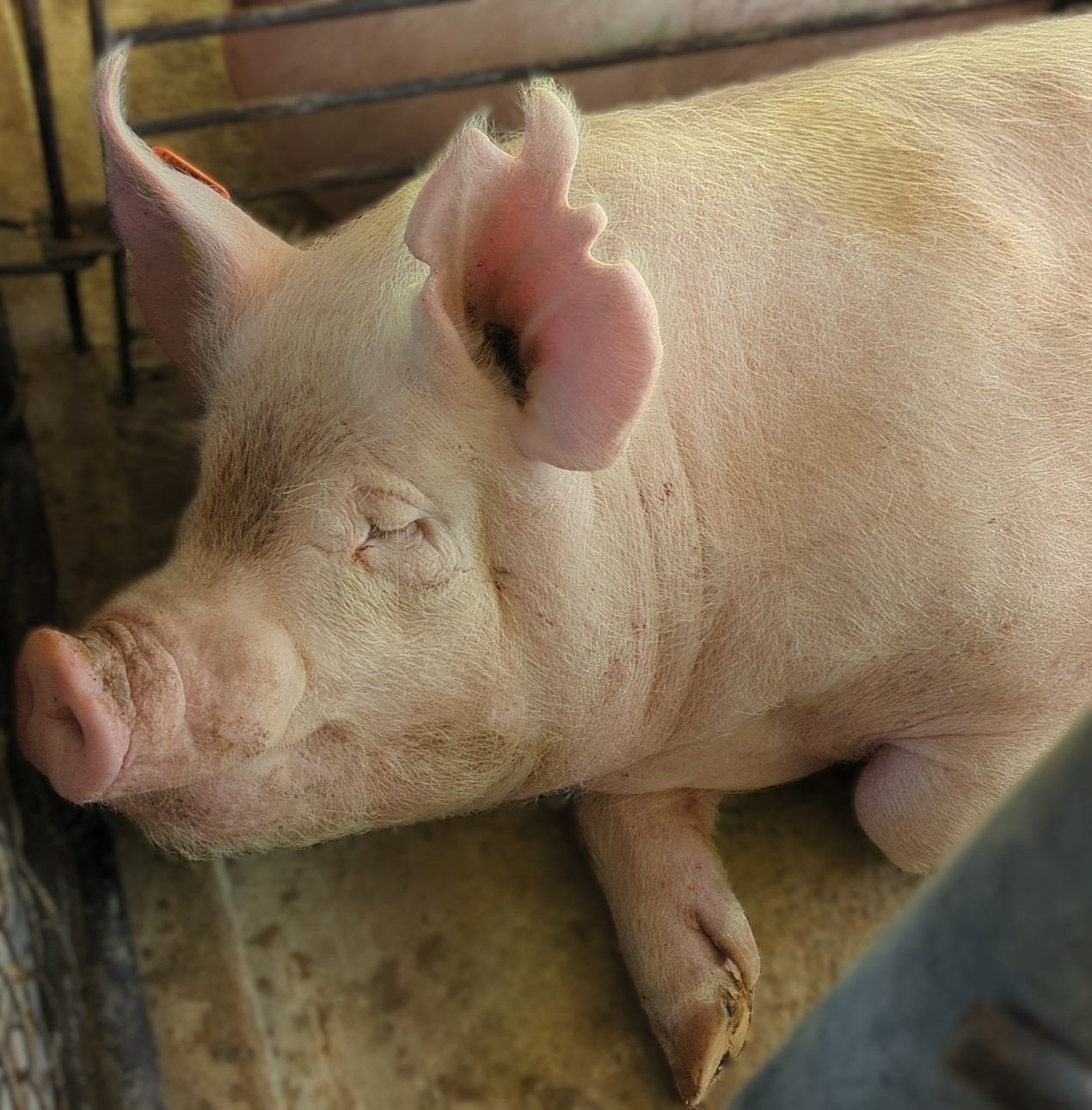
Image courtesy of Suzanne Leonard.
Swine geneticists have designed a sow that emulates a race car. She is sleek and lean and she has incredible piglet output. Yet, is our race car receiving high-performance fuel, or is she getting something that resembles 2-cycle fuel-something you may use to power your weed whacker or your leaf blower? With implementation of genomic selection, geneticists have been able to change the sow faster than ever. Yet, the nutritional requirements of this highly efficient female have changed and sow nutrition research takes time and funding. Hence, we may be looking at a genotype × environment interaction scenario where we have created a high-performing sow but are seeing engine troubles due to low-quality fuel.
In 2007, the late Dr. Mahan discussed potential nutritional strategies to enhance sow livability. He showed concentrations of antioxidants, specifically vitamins C and E, are reduced in late gestation. Once a sow’s antioxidant status is lowered, it could affect the responses of her tissues and perhaps even lead to death.
North Carolina State University Study
Therefore, a pilot study was designed (Knauer, 2023) to evaluate late gestation supplementation of vitamins C and E on sow survivability. Sows (n=466), housed in stalls at a commercial sow farm in eastern North Carolina, were randomly allocated to either receive 35 g of a top-dress containing vitamins C and E or no top-dress in the diet (Control). The 35 g top-dress contained 1.05 g of vitamin C (from STAY-C®35), 500 IU of vitamin E (from ROVIMIX®E50), and ground corn as a carrier. Vitamins C and E were top-dressed twice per week, from day 87 of gestation until farrowing. The farm’s gestation and lactation diets were formulated to contain no vitamin C and 66 IU/kg of vitamin E.
Sow survival was evaluated from day 95 of gestation through day 30 post-farrow. Mortality codes recorded by farm technicians included sudden death, lameness, prolapse and farrowing difficulty. Sow survival traits were analyzed using a Chi-square analysis.
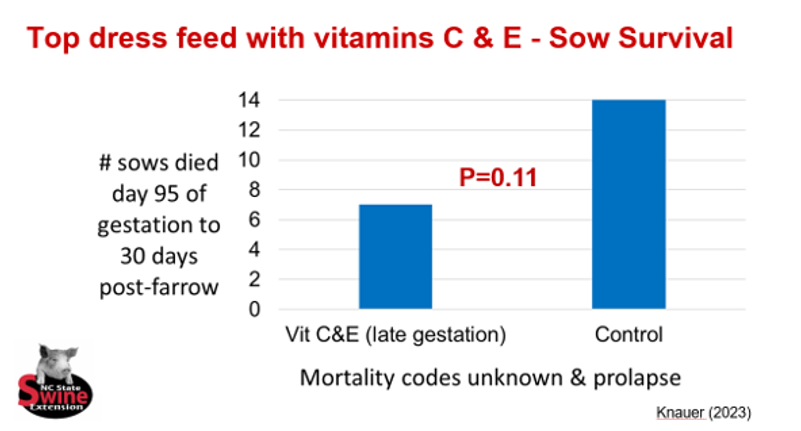
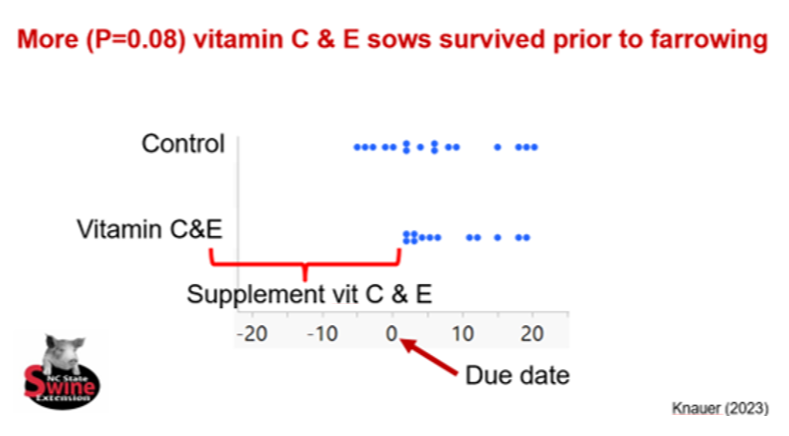
Of the 466 sows, 29 (6.2%) died or were euthanized between day 95 of gestation and 30 days post-farrow. Sows supplemented with vitamins C and E tended (P=0.11) to have lower incidences of sudden death and prolapse when compared to Control sows (Figure 1, 6.0 vs. 3.0%). Vitamin C and E supplementation tended (P=0.08) to reduce the number of sows that died at or before farrowing (Figure 2). Hence, results suggest that supplementation of vitamins C and E in late gestation may be a strategy to enhance sow livability. |
|
Underlying Biology
Oxidative Stress
Oxidative stress can be explained as an imbalance of free radicals and antioxidants in an animal that leads to cellular damage. Cellular damage can then lead to a variety of diseases.
Mahan et al. (2007) proposed oxidative stress as a potential cause of sudden death in sows. Vitamin supplementation needs are highest during periods of stress (Lauridsen, 2019). Furthermore, farrowing can be a stressful event in a sow’s life. Hence, enhancing the supplementation of certain vitamins in late gestation may be a strategy to improve sow health and survival at farrowing.
Anemia
Anemia can be characterized as a problem of not having enough healthy red blood cells or hemoglobin. Multiple forms of anemia exist. For example, anemia can result from a lack of iron in the body, yet anemia can also develop from the deficiency of certain vitamins.
Recent data suggests U.S. sow herds may have problems with sow anemia. Castevens et al. (2020) reported that 49.7% of sows evaluated in the U.S. were anemic. McClellan et al. (2024) found sow hemoglobin concentration had a moderate correlation with farrowing duration. Their data showed that sows with < 10 g/dL of hemoglobin had substantially longer farrowing durations than sows with > 10 g/dL (571 vs. 285 minutes). Harshman et al. (2023) reported non-prolapsed sows had substantially greater blood iron levels than prolapsed sows (3.76 vs. 2.77 ppm). These studies suggest that sow anemia near farrowing is associated with farrowing complications and sow mortality.
Enhanced vitamin supplementation may be part of the strategy to enhance sow hemoglobin concentration. Aznar et al. (2024) reported that vitamin C supplementation from day 76 to farrowing enhanced sow hemoglobin levels when compared to control-fed sows. In humans, it is well known that vitamin C enhances the adsorption of non-heme iron (Lane and Richardson, 2014). Hence, nutritional strategies to enhance sow hemoglobin concentration may likely include vitamin C supplementation.
We would like to thank our producer partners, DSM, and DSM scientists Dr. Jon Bergstrom and Dr. Sara Hough for their continued support. Questions can be directed to Mark Knauer @ mtknauer@ncsu.edu.
References
Castevens, K., Ferreira, J. B., Gillespie, T., Olsen, C., Nielsen, J. P., & Almond, G. 2020. Assessment of hemoglobin concentration in relation to sow reproductive stage and parity. Journal of Swine Health and Production, 28(5), 254-257.
Harshman, J. A., Carter, S. D., Daniels, C. S., Coble, K., & Madson, D. 2023. 196 Serum Trace Minerals and Tumor Necrosis Factor Alpha Concentrations in Prolapsed and Non-Prolapsed Sows. Journal of Animal Science, 101(Supplement_2), 242-242.
Knauer, M. 2023. PSIV-2 Impact of Vitamins C and E on Sow Mortality and Stillborn Rate. Journal of Animal Science, 101(Supplement_2), 352-353.
Lane, D. J., & Richardson, D. R. 2014. The active role of vitamin C in mammalian iron metabolism: much more than just enhanced iron absorption!. Free radical biology and medicine, 75, 69-83.
Lauridsen, C. 2019. From oxidative stress to inflammation: redox balance and immune system. Poultry science, 98(10), 4240-4246.
Mahan, D.C., J.C. Peters, and G.M. Hill. 2007. Are antioxidants associated with pig and sow mortalities? Midwest Swine Nutrition Conference. pp. 13-21 Indiana Farm Bureau.
Indianapolis, IN.
McClellan, K. A., Sheffield, S. L., & Levesque, C. L. 2024. The impact of hemoglobin concentration on farrowing duration in sows. Translational Animal Science, 8, txae158.
Sosnowska, A., Kawęcka, M., Jacyno, E., Kołodziej-Skalska, A., Kamyczek, M., & Matysiak, B. 2011. Effect of dietary vitamins E and C supplementation on performance of sows and piglets. Acta Agriculturae Scandinavica, Section A-Animal Science, 61(4), 196-203. |