Share
 
No. 117                                                                                                July 2026
Banner for "Driptorch Digest: News for the Southern Prescribed Fire Community." The graphic features a red horizontal band with white and red text. To the left, a circular inset photo shows two metal drip torches standing on the ground in a forest during a prescribed burn, with smoke and low flames in the background.
The NC State Extension logo. On the left, a red rectangular block contains the words "NC STATE" in bold white capital letters. To the right, the word "EXTENSION" is written in large black capital letters on a white background.
 
The SERPPAS logo, featuring the acronym "SERPPAS" in large, bold black capital letters. Below the acronym, the full name "Southeast Regional Partnership for Planning and Sustainability" is written in a smaller black font.
A green silhouette map of the Southeastern United States from the SERPPAS logo, showing the regional outline from Texas and Oklahoma over to the Atlantic coast and down through Florida. The map is partially enclosed by a thin, green elliptical swoosh.
 
U.S. Wildland Fire Service Announces New Measures for Firefighter Health and Smoke Exposure
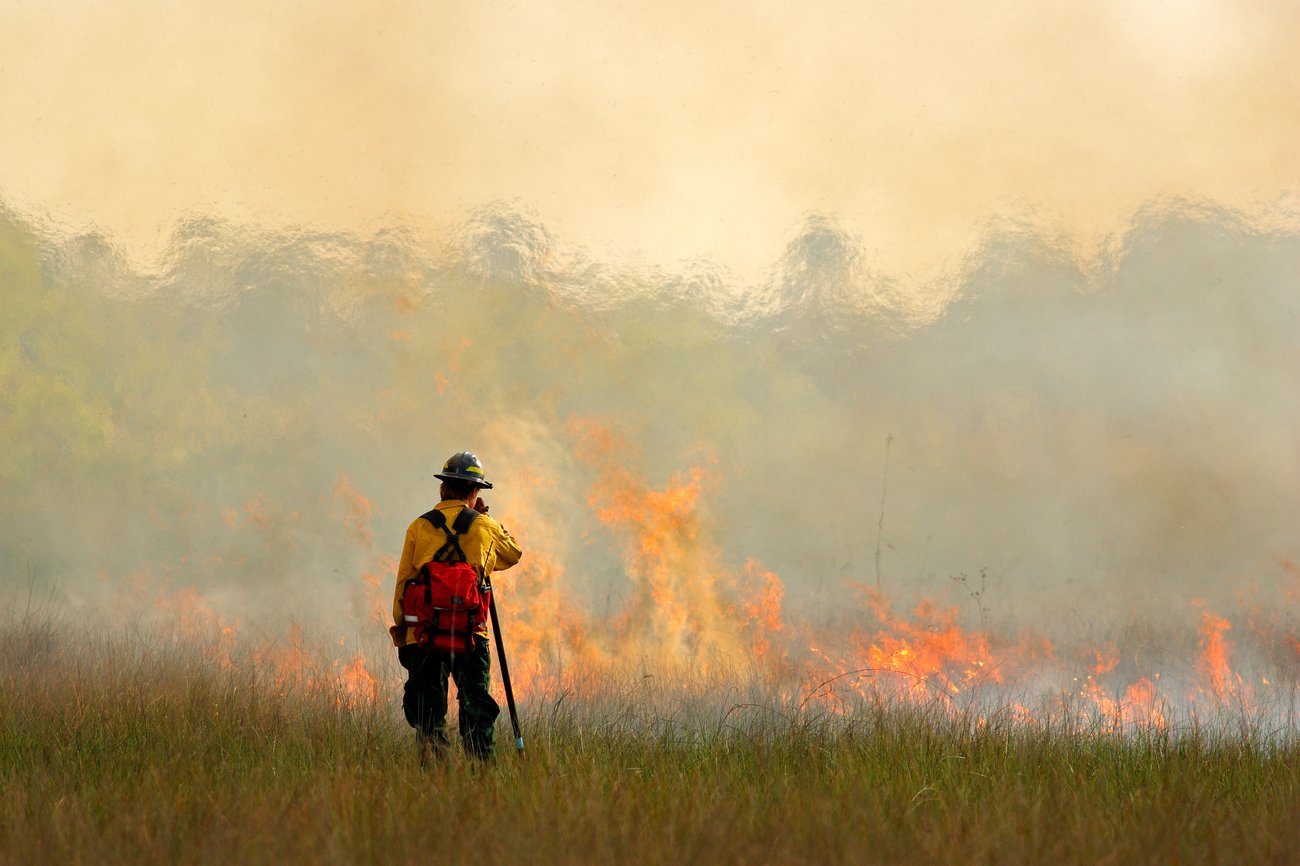
A wildland firefighter stands in a grassy field with their back to the camera, monitoring a line of bright orange flames and thick smoke sweeping across the landscape. The firefighter wears a yellow fire-resistant jacket, dark green pants, a hard hat, and a prominent red backpack while holding a tool or radio. In the background, intense heat waves blur the upper horizon against a hazy, smoke-filled sky.
The U.S. Wildland Fire Service has announced immediate interim measures to reduce firefighter exposure to toxic smoke, ash, and airborne particulates on the fireline. Developed by the Federal Wildland Firefighter Health and Wellbeing Program, a joint effort between the Departments of the Interior and Agriculture, these guidelines authorize federal firefighters to use N95 respirators during active operations for the first time, provided they complete specialized training. Because no respirator is currently fully certified for extreme wildland firefighting conditions, these science-informed steps offer a crucial immediate defense against long-term respiratory health risks.

In addition to inhalation hazards, the new directives tackle the issue of lingering contaminants on skin and gear. The agency is standardizing on-the-job decontamination protocols, which include expanding access to showers, routine equipment cleaning, and clean-air recovery periods during fire assignments. Crucially, firefighters will now be compensated for the time spent performing these decontamination practices. These updates represent an important interim milestone in safeguarding personnel health and wellbeing as the agency works toward long-term, OSHA-aligned respiratory protection programs.

 
Tippin' Torch: Tips for the Season
A simplified, clean-line illustration of a metal drip torch on a white background. The torch is shown at a slight angle, highlighting the cylindrical fuel tank, top handle, and
the long spout with its distinctive pigtail loop leading to the igniter tip.
As we head into the July Fourth weekend, it is a good time to remember to be safe using fireworks. Regions of the Southeast are still experiencing significant drought, and Eastern Texas and Louisiana will experience above-normal wildland fire potential in July and August. These drought conditions will heighten the wildfire risk posed from home fireworks. Many fire officials recommend viewing professional firework celebrations instead of lighting home fireworks.

If you decide to use fireworks for Fourth of July this year, check out this short selection of useful resources below on firework safety and best practices:


Monthly Update for Prescribed Burn Associations in the Southeast

Conducting spring growing-season burns on small-acreage tracts presents unique hurdles, but meticulous planning can help private landowners successfully restore their ecosystems. In a recent article from The Longleaf Alliance, Restoration Coordinator Mark McClellan describes a recent prescribed burn success story on a small burn unit in Georgia. The article outlines strategic approaches to overcoming the challenges of burning smaller properties, where a lack of heavy equipment and tight boundaries amplify risks. Careful preparation of firebreaks and careful observation of weather forecasts help ensure that smoke is safely routed away from nearby smoke-sensitive neighbors.

To learn about picking the right burning day for your land, a webinar will be held on July 23, 2026 at 6:00 PM ET. Registration is available now!

A new incident review map from the Wildland Fire Lessons Learned Center has been released for fire practitioners to review lessons from fire incidents in their local region.


For more resources on PBAs, please visit the Southeast Prescribed Fire Update website, under the "Prescribed Burn Associations" tab.

    Prescribed Fire News Roundup
     
    Prescribed Burn Unit Stops Wildfire Spread in North Carolina Sandhills Region
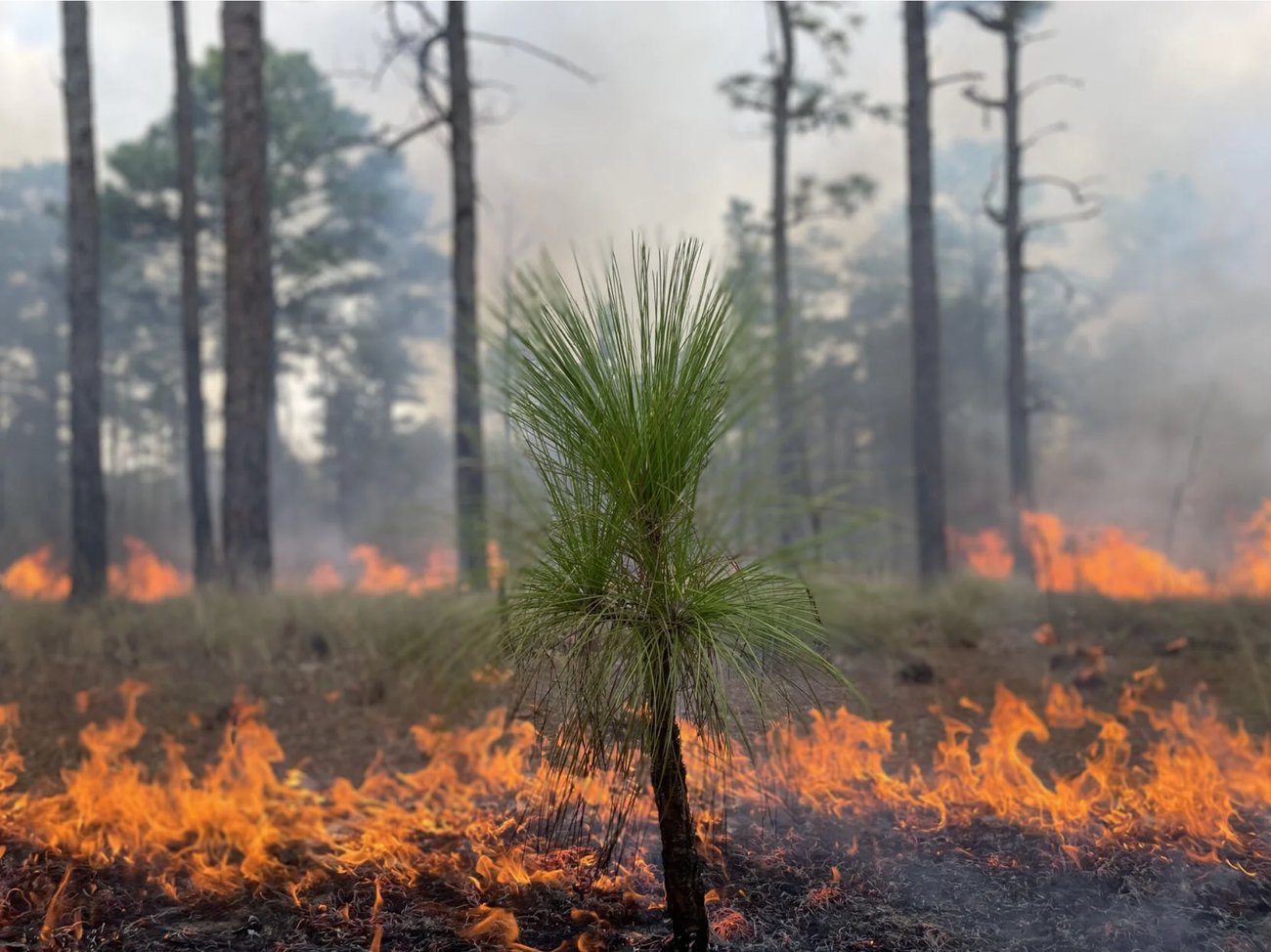
    A close-up shot of a small, young longleaf pine sapling standing resiliently in the foreground as low, bright orange flames consume the dry pine needles and ground cover around its base. In the background, tall pine trees rise through a smoky haze, with patches of a controlled burn or wildfire spreading across the forest floor.
    Photo Credit: Alan Teed
    A recent article from The Pilot highlighted a recent success story in the North Carolina Sandhills region on The Nature Conservancy's management lands. During a period of high fire activity in Moore County last April, an eight-acre wildfire moving toward a residential area was contained when it reached an adjacent plot of land that had undergone a prescribed burn one month earlier. This incident demonstrates how strategic fuel reduction can mitigate fire intensity and protect nearby homes. Local forestry officials and Burn Boss Alan Teed emphasize that these meticulous, weather-dependent prescribed fires are essential proactive safety measures for preventing wildfire spread.
         
        NWCG Safety Bulletin Addressing a Seasonal Surge in Firefighter Rhabdomyolysis Cases
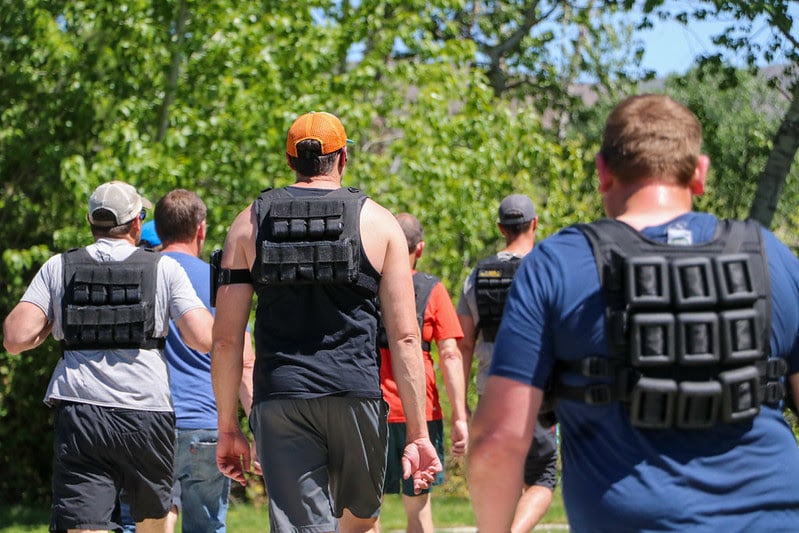
        The National Wildfire Coordinating Group (NWCG) Risk Management Committee has issued a safety bulletin following a noticeable spike in heat-related illnesses and rhabdomyolysis (rhabdo) among wildland firefighters in May, June, and July. Surprisingly, data shows a high percentage of these severe muscle-breakdown cases occur during early-season Work Capacity Tests (the "pack test") rather than active fire suppression, often because elite crew members ignore pain before they are fully acclimated to the heat. Because delayed symptoms like severe swelling or tea-colored urine may not appear for two to three days, the NWCG has revitalized its medical education resources to help fire personnel immediately recognize, report, and treat this highly individualized and life-threatening condition.
            A view from behind of a group of men walking outdoors on a sunny day, taking part in a pack test. Several of the men are wearing heavy, black weighted vests over their t-shirts and tank tops. Lush green trees and foliage line the path ahead of them under a clear blue sky.
            Photo Credit: National Wildfire Coordinating Group
             
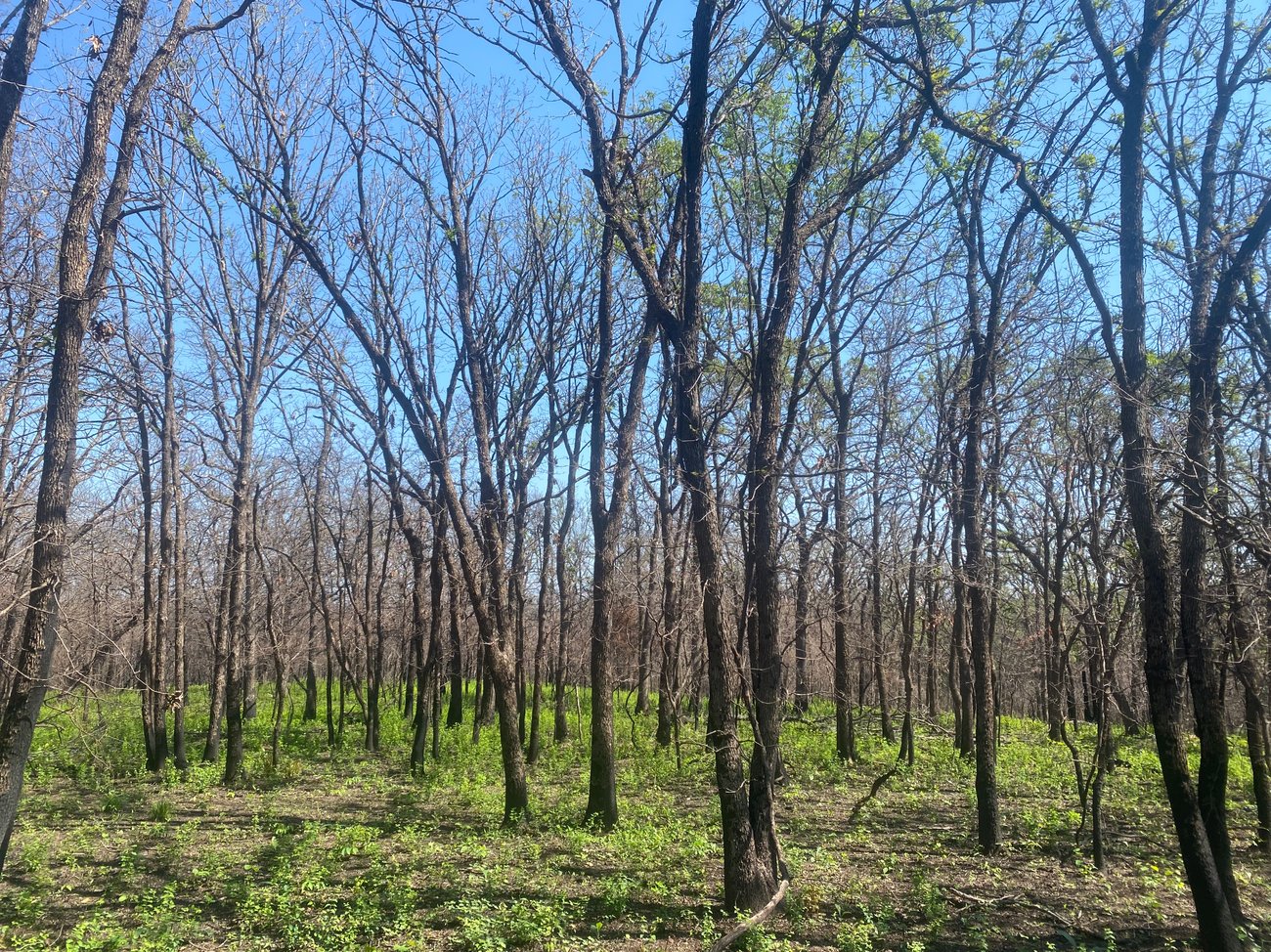
            New Fact Sheet Released: The Effect of Wildfire on Managed vs. Unmanaged Forests
            A view looking into a dense, unmanaged Cross Timbers forest on a clear, sunny day. Numerous slender, dark-barked deciduous trees with mostly bare branches fill the frame, stretching toward a vibrant blue sky. Bright green undergrowth and low-lying vegetation carpet the forest floor, contrasting with the dark trunks and dry wood.
            Photo Credit: Oklahoma State University NREM Extension
            An Oklahoma State University Extension fact sheet highlights the stark contrast in how managed and unmanaged Cross Timbers forests respond to intense wildfire. Research showed that forest plots previously treated with prescribed fire and canopy reduction experienced significantly less tree mortality because dangerous ladder fuels, like invasive eastern redcedar, had already been removed. While the understory vegetation in all areas grew back rapidly within three months of a wildfire, the previously managed plots rebounded with high-quality perennial grasses suitable for livestock and wildlife, whereas unmanaged stands were dominated by less desirable annual weeds.
               
              Other Fire Highlights and News
               
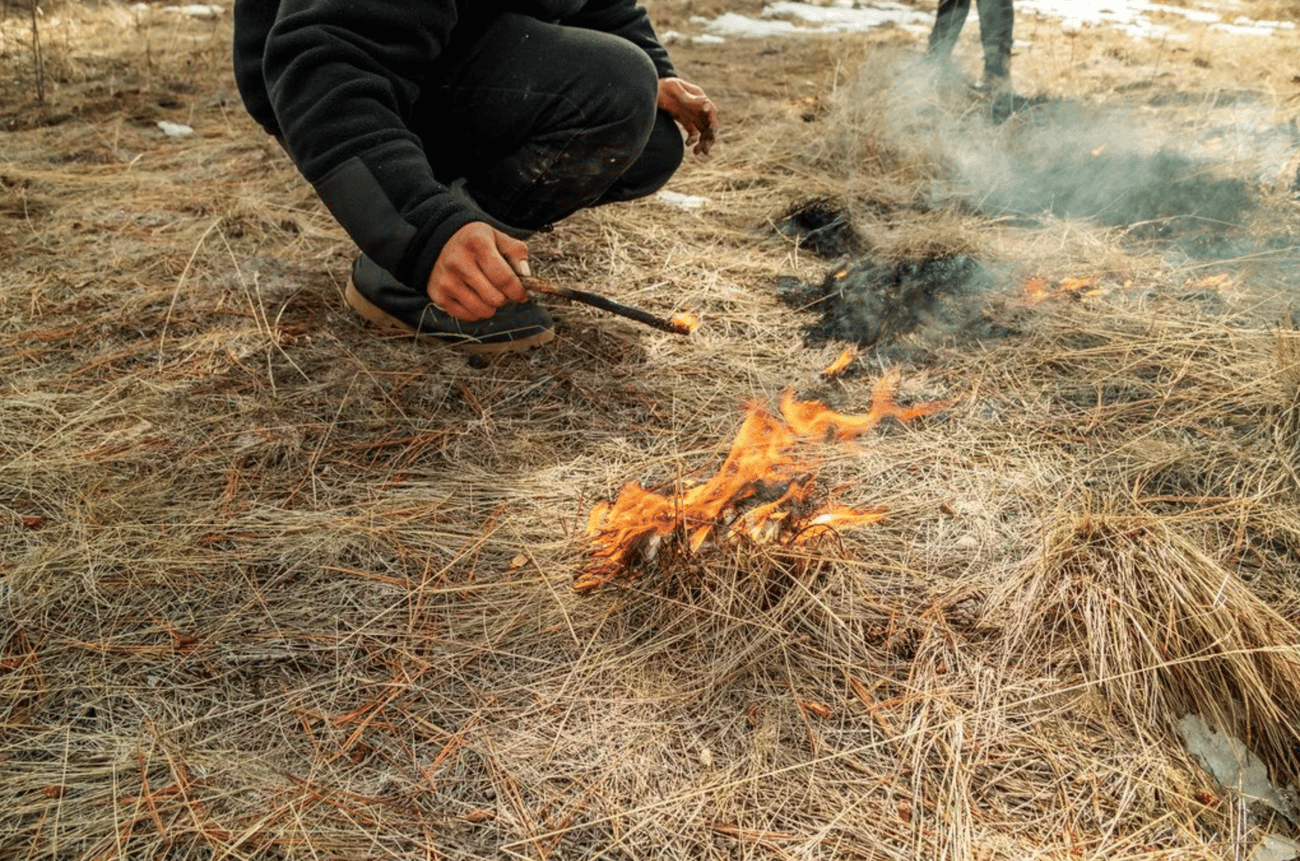
              Addressing Myths and Facts: The Truth About Indigenous Cultural Fire
              A close-up, low-angle shot of a person crouching down in a field of dry, brown grass. The person is using a small, burning stick held in their hand to deliberately ignite a small patch of grass, creating bright orange flames. In the upper right background, a small patch of scorched earth produces wisps of smoke, and the legs of another person can be seen standing nearby.
              Photo Credit: Indigenous Leadership Initiative
              A recent article from the Indigenous Leadership Initiative addresses common myths surrounding Indigenous cultural fire. While often confused with agency-led prescribed burns, true cultural fire is deeply rooted in Indigenous governance, territory lineage, and wide-ranging land stewardship that extends far beyond small, localized communities. The article highlights that this ancient practice is fully compatible with modern management practices. Indigenous fire keepers actively adjust their traditional methods, such as incorporating mechanical thinning when heavy fuel loads exist, to safely restore forest health, enhance biodiversity, and mitigate the risk of high-intensity wildfires today.
                 
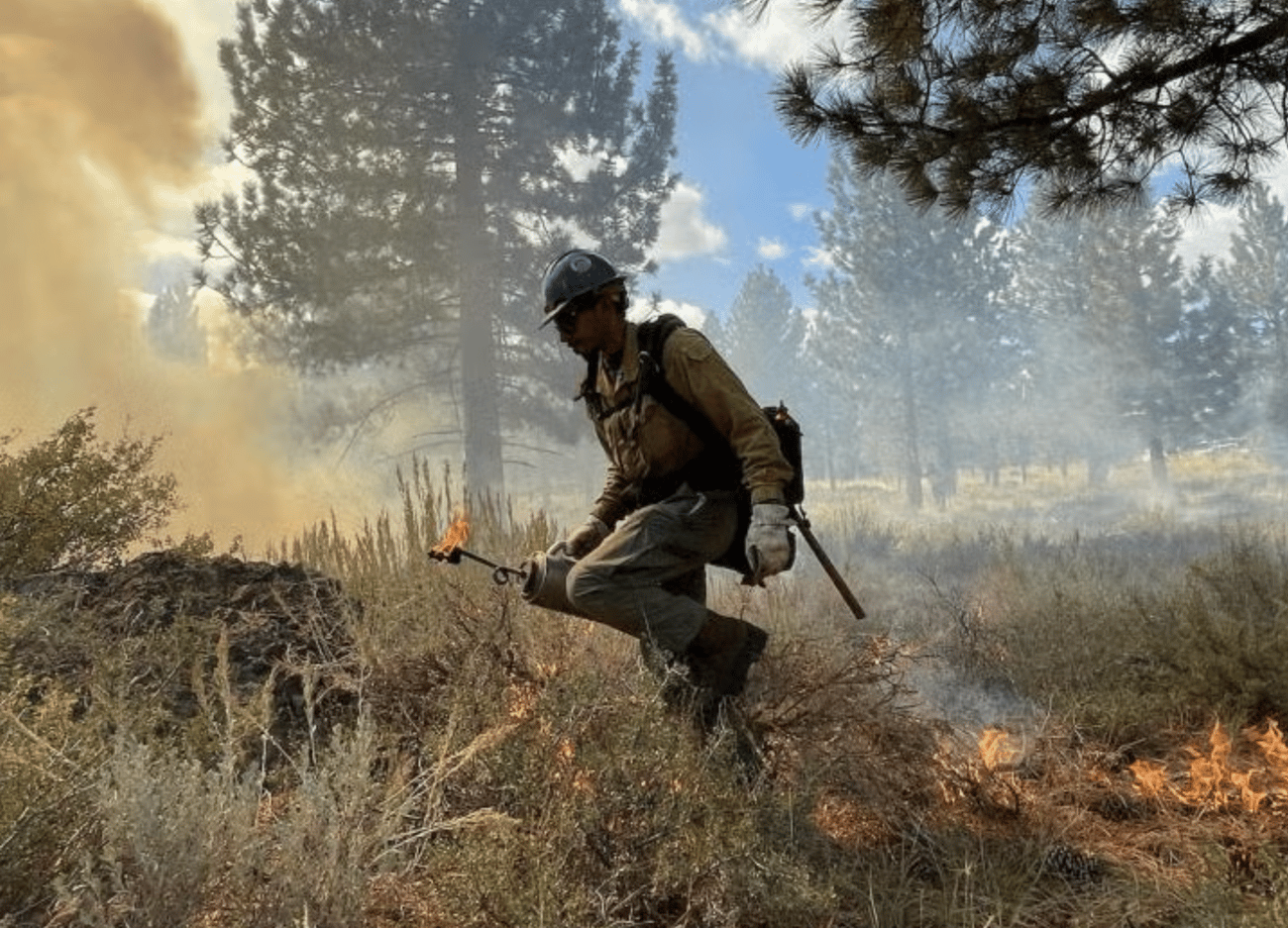
                New Study on the Economic Benefits of Preventative Forest Fuel Treatments
                New research from UC Davis suggests that investing in forest fuel treatments yields substantial financial and societal returns and reduced wildfire spread and severity. Researchers analyzed nearly 300 wildfires across the western United States to demonstrate that every dollar spent on forest thinning and prescribed burns saves approximately $3.75 in overall wildfire damages. Forest fuel treatments reduced total burned acreage by 36% and significantly lowered the occurrence of devastating, high-severity crown fires. An estimated $2.8 billion in avoided losses extends far beyond saving infrastructure, directly preventing premature deaths and saving over a billion dollars by curbing toxic smoke pollution and carbon emissions.
                A wildland firefighter in a hard hat, protective clothing, and gloves walks through brush and low vegetation while using a drip torch to set a controlled fire. Small flames ignite on the ground behind them, and a thick plume of yellowish-tan smoke rises into the air next to tall pine trees under a partly cloudy sky.
                Photo Credit: USDA Forest Service photo by Lisa Cox
                 
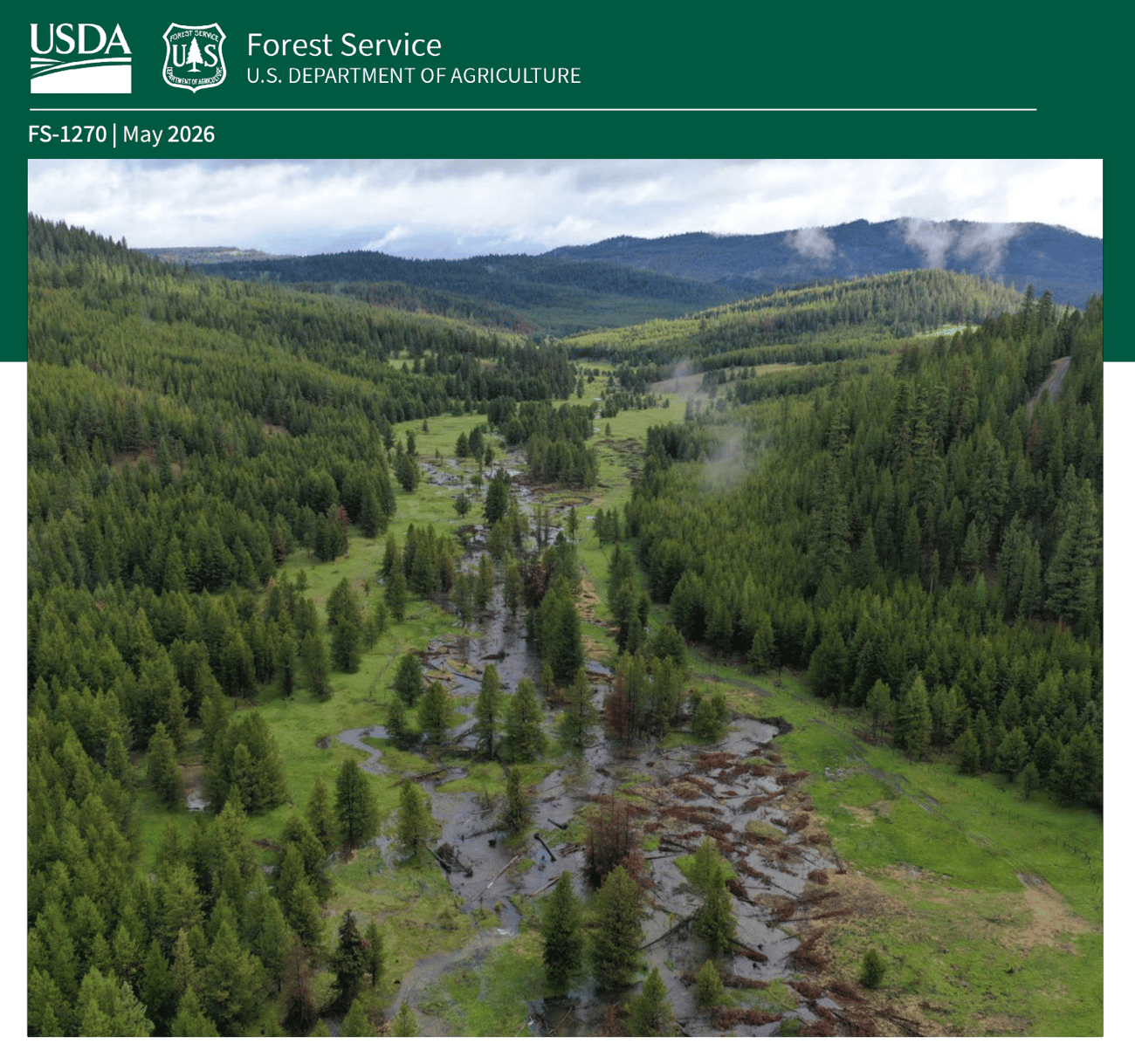
                U.S. Forest Service Publication Highlights Using Stream Restoration for Wildfire Resilience
                A document header from the USDA Forest Service, dated May 2026 (FS-1270), features a wide aerial view of a lush mountain valley. A winding stream flows through a grassy meadow littered with fallen logs and debris, surrounded by dense evergreen pine forests on both sides. In the distance, rolling green hills and forested mountains rise beneath a cloudy, overcast sky with patches of low-hanging mist.
                Photo Credit: USDA Forest Service
                A recent publication from the U.S. Forest Service discusses integrating stream and river restoration into fire planning as a cost-effective strategy for creating highly resilient "wet fuel breaks" in valleys and meadows. Using unmarketable wood and debris to mimic natural beaver dams raises local water tables and significantly boosts soil moisture. This innovative technique directly strengthens natural fire containment lines and serves as a reliable boundary for future prescribed burning operations. Restoring these vital wetlands allows landscapes to better withstand wildfires, provides a safe refuge for fish and wildlife, and naturally filters post-fire ash and sediment from downstream waters.

                   
                  Funding Resources
                   
                  The official logo for the Natural Resources Conservation Service (NRCS). It features a stylized blue water droplet cradled by a green semi-circle on the left, with the large blue letters "NRCS" and the full name "Natural Resources Conservation Service" written in black below.


                  The official logo of the North Carolina Forest Service. It is a shield-shaped emblem featuring a red background with a white and red border. An arched green banner at the top reads "NORTH CAROLINA" in white capital letters. The center of the shield contains the words "FOREST SERVICE" in white, positioned above the large white letters "N" and "C," which flank a stylized green evergreen tree icon.
                   
                   
                  Logo of the Georgia Wildlife Federation in green and white. The circular emblem features negative space and interlocking silhouettes to depict various animals, including a deer with antlers, a bear, a bird, and a fish at the bottom. The text "GEORGIA WILDLIFE FEDERATION" arches over the top of the circle, and the tagline "Keeping GEORGIA Wild" is written along the bottom border.
                   
                  The official circular logo patch for the Texas A&M Forest Service. It features a dark green outer ring enclosing a light beige center. White text along the upper half of the green ring reads "TEXAS A&M FOREST SERVICE," and the year "1915" is written at the bottom. In the center, a large, dark green five-pointed star is overlaid with a stylized arrowhead icon split vertically into green and beige halves.
                   
                   
                  The official circular logo patch for the Texas A&M Forest Service. It features a dark green outer ring enclosing a light beige center. White text along the upper half of the green ring reads "TEXAS A&M FOREST SERVICE," and the year "1915" is written at the bottom. In the center, a large, dark green five-pointed star is overlaid with a stylized arrowhead icon split vertically into green and beige halves.
                   
                   
                  • The N.C. Forest Service is accepting applications through its new Disaster Mitigation Program to assist public and private landowners in reducing heightened wildfire risks across 39 counties impacted by Hurricane Helene. Funded by a grant from the USDA Forest Service, this program aims to lower the risk of catastrophic wildfire impacts to homes, infrastructure, and natural resources by targeting hazardous fuel buildup and fallen timber at no cost to the landowner.

                  Funding available for:
                  • Hazard reduction prescribed burning
                  • Home ignition zone treatments (defensible space creation)
                  • Fuel break and road restoration to reopen emergency access routes

                  Application deadline: Ongoing until funds are fully exhausted
                  • The Georgia Wildlife Federation (GWF) is accepting applications through its Longleaf Cost Share Assistance Program to assist private landowners in establishing new stands of longleaf pine. GWF will provide cost-share of up to $4,000 per landowner for new longleaf pine stand establishment and $15 per acre (up to $1,000 per landowner) for management of existing longleaf pine stands.

                  Funding available for:
                  • Establishing new stands of longleaf pine, including site preparation and planting
                  • Management of existing longleaf pine stands

                  Application deadline: July 10
                  • The Texas A&M Forest Service is accepting applications through its Prescribed Fire Grants program to assist private landowners and municipalities across Texas in implementing planned, low-intensity burns. The program aims to protect high-risk communities from catastrophic wildfires by reducing hazardous fuel loads while simultaneously promoting ecosystem restoration and improving rangeland health.

                  Funding available for multiple opportunities:

                  Application deadline: July 14
                  • The Texas A&M Forest Service is accepting applications through its Mechanical Fuel Reduction Grant program to assist private landowners and municipalities across Texas in creating defensible space or fuel breaks for protection against wildfire. The program aims to protect high-risk communities from catastrophic wildfires by reducing hazardous fuel loads through mechanical fuel reduction.

                  Funding available for:

                    • Creating defensible space and/or fuel breaks with hand cutting tools, chainsaws, chippers, and/or forestry mulcher/masticator

                  Application deadline: July 14
                  Job Opportunities
                   
                  Prescribed Fire Practitioner II
                  • Remote across United States
                  • The Nature Conservancy
                  • Closes July 6


                  Prescribed Fire Practitioner III
                  • Remote across United States
                  • The Nature Conservancy
                  • Closes July 6


                  Prescribed Fire Practitioner IV
                  • Remote across United States
                  • The Nature Conservancy
                  • Closes July 6


                  Coastal Prescribed Fire Crew
                  Technician


                  Prescribed Fire Crew Technician
                  (Mountain Region)


                  Habitat Specialist
                  • Columbia, SC
                  • Pheasants Forever/Quail Forever
                  • Open Until Filled


                  Fuels Monitoring Module
                  Crewmember

                  • Greenville, SC
                  • The Ember Alliance
                  • Open Until Filled
                   
                   
                  Operations Assistant (Temporary)
                  • Current assigned federal duty station or Tallahassee, FL
                  • Prescribed Fire Training Center
                  • Closes August 1
                   
                  Training Specialist (Temporary)
                  • Current assigned federal duty station or Tallahassee, FL
                  • Prescribed Fire Training Center
                  • Closes August 1
                   
                    Ecological Forester/Certification
                    Coordinator

                  • Atlanta, GA
                  • The Nature Conservancy
                  • Open Until Filled
                   
                  USGS Fire-Climate Adaptation Fellow
                  • Columbia, SC, Raleigh, NC, Gainesville, FL, or Remote
                  • Southeast Climate Adaptation Science Center/USGS
                  • Closes July 13
                   
                   
                  Blacksburg Prescribed Fire and Fuels Crew Lead (SRB)
                  • Blacksburg, VA
                  • The Ember Alliance
                  • Open Until Filled
                   
                   
                  Blacksburg Prescribed Fire and Fuels Crew Member (FFT1, FAL2)
                  • Blacksburg, VA
                  • The Ember Alliance
                  • Open Until Filled
                   
                  Blacksburg Prescribed Fire and Fuels Crew Member (FFT2)
                  • Blacksburg, VA
                  • The Ember Alliance
                  • Open Until Filled


                  Call-When-Needed Wildland Fire Training Instructor
                  • Fort Collins, CO (Employees can work remotely)
                  • The Ember Alliance
                  • Open Until Filled
                   
                  Check out this useful Sparked Resources webpage for useful resources on fire career paths.
                  Check out this dedicated SAFE community Discord server to connect with students nationwide on fire ecology.
                  Check out this Association for Fire Ecology website for students studying fire.
                  Check out the FireUp job board, a job posting site for fire and forestry work.
                   
                  Upcoming Events
                   
                   
                  Fire Training Courses and Workshops


                  Self-Guided
                  Virtual
                   

                  Self- Guided
                  Virtual
                   
                  July
                  21-23
                  Virtual with In-Person Field Trips
                   
                   
                  August
                  8
                  Salisbury, NC
                   
                   
                  September
                  14-16
                  College Station, TX
                   
                  October
                  12-14
                  Virtual with In-Person Field Days


                  Self-Guided
                  Virtual
                   
                  July
                  10
                  Paducah, TX
                   
                  August
                  2-8
                  Columbus, AR


                  September
                  11-19
                  Pineville, KY
                   
                   
                  September
                  25
                  Hunt, TX


                  Consult this SAWFIT website for a useful resource on other fire trainings offered across the Southeast.
                   
                  Webinars
                   
                  July
                  8
                  Virtual
                   
                  July
                  28
                  Virtual
                   
                  September
                  14
                  Virtual
                   
                  September
                  8
                  Virtual


                  July
                  23
                  Virtual
                   
                  August
                  5
                  Virtual
                   
                  September
                  2
                  Virtual
                   
                  October
                  7
                  Virtual


                  Conferences, Meetings, and Other Events
                   
                  August
                  4-6
                  Alva, OK
                   
                  October
                  13-16
                  Hopkinsville, KY
                   
                  October
                  26-30
                  Nashville, TN


                  August
                  26-27
                  Nags Head, NC
                   
                  October
                  23
                  Kissimmee, FL
                   
                  October
                  27-30
                  Williamsburg, VA


                  Consult the Wildfire Conferences website for a useful resource on other fire conferences offered globally.

                  Subscribe to Wildfire Today, a wildfire news & opinion site.

                  Share your stories, events, and information in the next issue:

                  Sarah Cain: sacain2@ncsu.edu
                  Jennifer Fawcett: jennifer_fawcett@ncsu.edu

                  Facebook
                   
                  Instagram
                   
                  Website
                   
                  Email
                  The Driptorch Digest is distributed by NC State University as a project of the Southeast Regional Partnership for Planning and Sustainability (SERPPAS) Prescribed Fire Working Group.

                  NC State University promotes equal opportunity and prohibits discrimination and harassment based upon one’s race; color; religion (including belief and non-belief); sex, including but not limited to pregnancy, childbirth, or other related medical condition, parenting, and sexual harassment; sexual orientation; actual or perceived gender identity; age; national origin; disability; veteran status; or genetic information.

                  This newsletter is made possible through a grant from the National Fish and Wildlife Foundation, with support from the USDA Forest Service and the Department of Defense.