Share
 
No. 116                                                                                               June 2026
Banner for "Driptorch Digest: News for the Southern Prescribed Fire Community." The graphic features a red horizontal band with white and red text. To the left, a circular inset photo shows two metal drip torches standing on the ground in a forest during a prescribed burn, with smoke and low flames in the background.
The NC State Extension logo. On the left, a red rectangular block contains the words "NC STATE" in bold white capital letters. To the right, the word "EXTENSION" is written in large black capital letters on a white background.
 
The SERPPAS logo, featuring the acronym "SERPPAS" in large, bold black capital letters. Below the acronym, the full name "Southeast Regional Partnership for Planning and Sustainability" is written in a smaller black font.
A green silhouette map of the Southeastern United States from the SERPPAS logo, showing the regional outline from Texas and Oklahoma over to the Atlantic coast and down through Florida. The map is partially enclosed by a thin, green elliptical swoosh.
 
New Southern U.S. Prescribed Fire Annual Liability Report Released
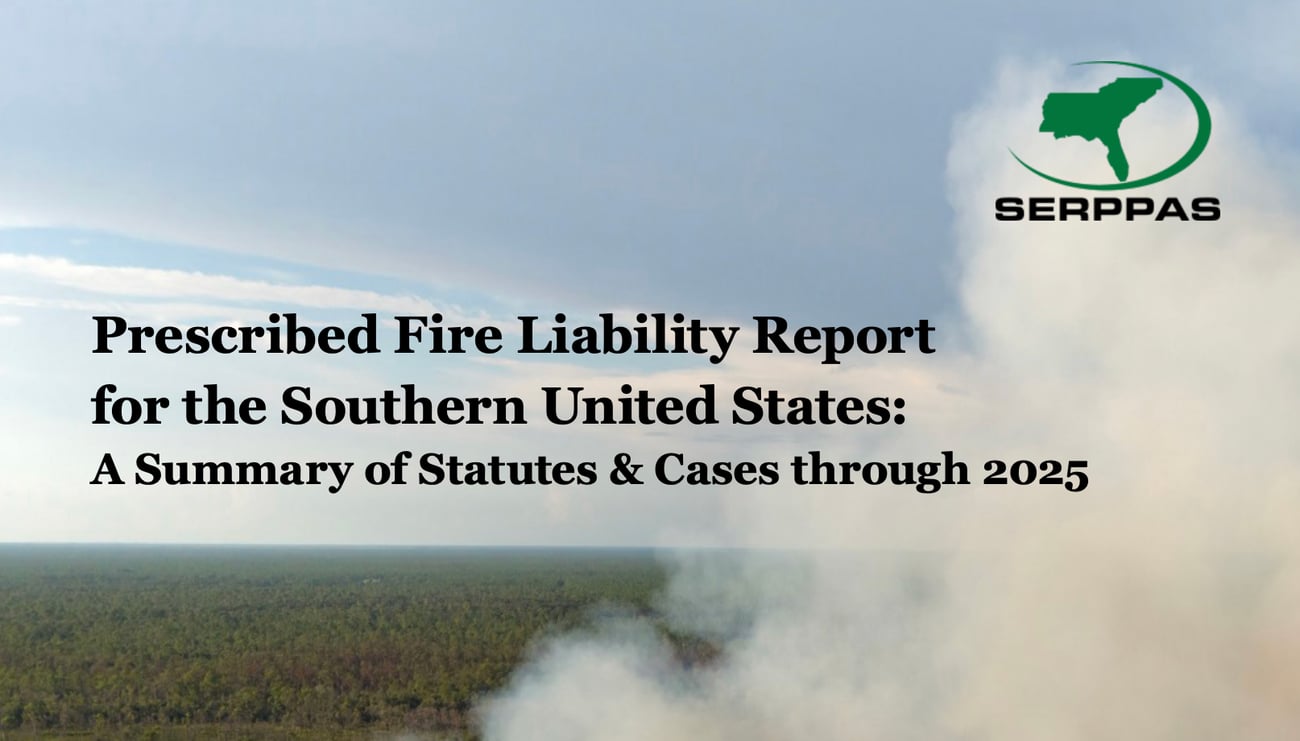
The cover image of a regional presentation or report title slide about prescribed fire liability laws. The Text: Large, bold black serif text on the left side of the slide reads: "Prescribed Fire Liability Report for the Southern United States: A Summary of Statutes & Cases through 2025." The Background: The background is an aerial, high-angle photograph looking across a vast, flat expanse of a green forest canopy. On the right side of the frame, a large column of thick, white smoke from a prescribed fire rises into a light blue sky dotted with soft clouds. The Logo: In the upper right corner sits the SERPPAS (Southeast Regional Partnership for Planning and Sustainability) logo, which features a green circular emblem containing a map silhouette of the southeastern United States above
the word "SERPPAS" in bold black capital letters.
The 2025 Prescribed Fire Liability Report for the Southern United States from the Southeastern Regional Partnership for Planning and Sustainability Wildland Fire Work Group has now been released. Led by Brooks Pierce Law Firm, the report provides a comprehensive overview of how statutory laws and legal precedents govern controlled burning across the region. It analyzes how different southern states handle liability, specifically highlighting the legal distinctions between simple negligence, gross negligence, and strict liability standards, and how these rules directly impact a burner's exposure to lawsuits in the event of an escaped fire or smoke incident.

This updated report serves as a critical guide for land managers and policymakers. In addition to summarizing state-by-state statutory frameworks, the report details evolving case law and the role of certified prescribed burn manager programs in current state laws.

 
Tippin' Torch: Tips for the Season
A simplified, clean-line illustration of a metal drip torch on a white background. The torch is shown at a slight angle, highlighting the cylindrical fuel tank, top handle, and
the long spout with its distinctive pigtail loop leading to the igniter tip.
The classic signs of southern spring and summer are appearing: the forests are green, the cicadas are singing, and the air is hot and stuffy. Above-normal temperatures are likely over the next few months and as we go out into that heat to do work, let's remind ourselves about the risks and mitigations of heat-related illness. Checkout this short selection of useful resources below:

 
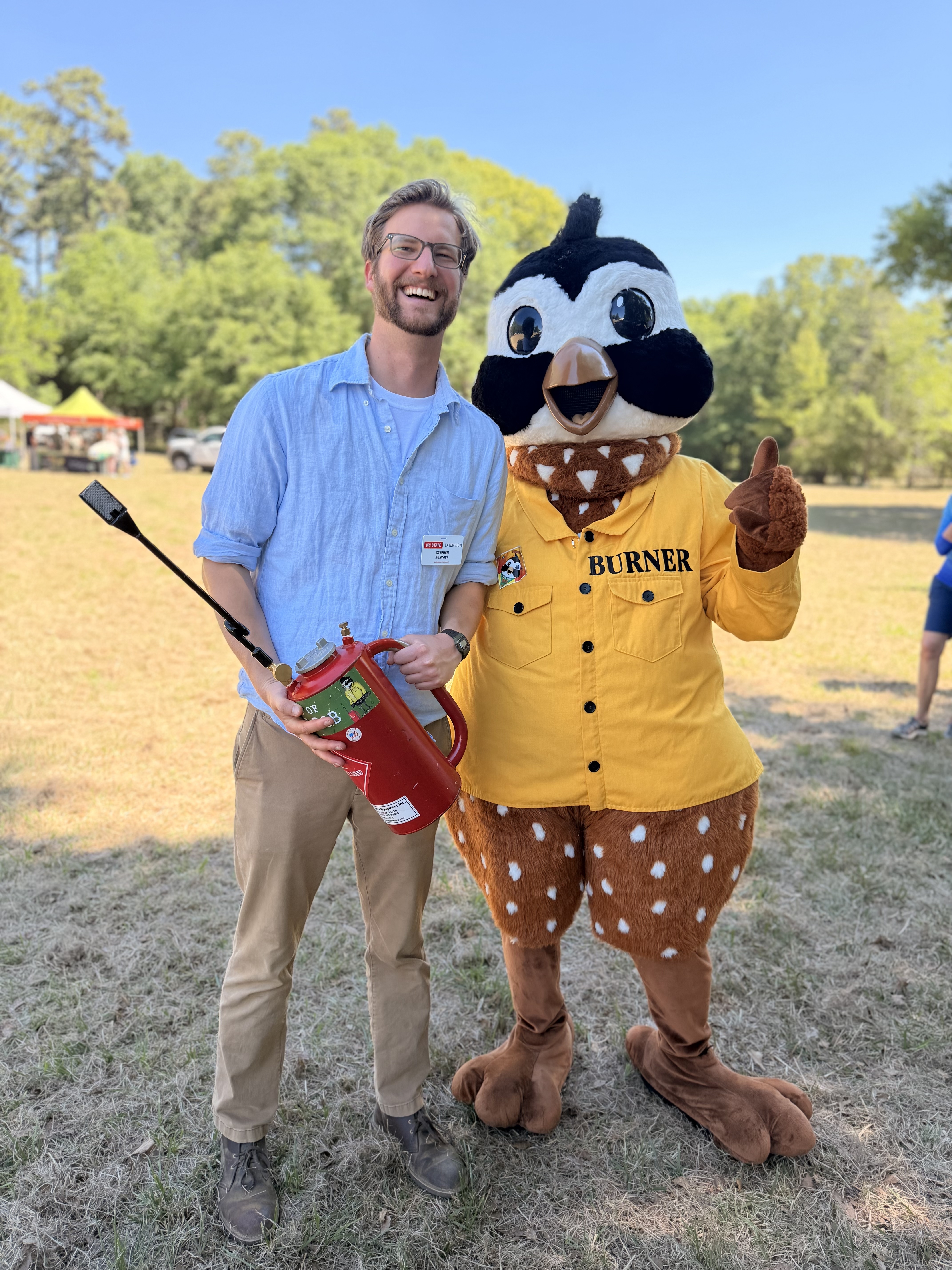
Extension Associate Stephen Ruswick, holding a red driptorch, stands with Burner Bob at the Party for the Pine Fire Festival.
Welcome to the team Stephen!

Please give a warm welcome to the newest member of the NC State Extension Forestry Team, Stephen Ruswick!

Stephen is an Extension Associate in wildland fire, working with student fire training at NC State on an America's Ecosystem Restoration Initiative grant, in collaboration with the Southeastern Regional Partnership for Planning and Sustainability (SERPPAS).

Before joining NC State Extension, Stephen was a Fire Specialist with The Nature Conservancy in Pennsylvania for 3 years, assisting state agencies with prescribed fire operations and training. He served on the Pennsylvania Prescribed Fire Council’s board of directors from 2024 to 2026 and helped create the state’s Certified Burn Manager program. Stephen graduated from SUNY Geneseo with a B.S. in Biology in 2015 and an M.S. in Forestry from the University of Georgia in 2018.
     
    Monthly Update for Prescribed Burn Associations in the Southeast

    Conducting post-burn evaluations is a critical step for land managers to determine whether a prescribed fire successfully met their land management objectives. In this article, Tall Timbers describes important aspects of a post-burn evaluation. Assessing a recent burn helps cut management costs by pinpointing where vegetation control goals were already achieved, avoiding unnecessary mowing or mechanical treatments. A post-burn walkthrough also offers a perfect window to easily spot, map, and treat emerging invasive plants or target unburned patches in future burn planning that require harsher conditions to successfully ignite.

    To learn more about burn planning and mapping for your burn plans, a webinar will be held on June 10, 2026 at 5:30 PM ET. Registration is available now!

    For more resources on PBAs, please visit the Southeast Prescribed Fire Update website, under the "Prescribed Burn Associations" tab.

      Prescribed Fire News Roundup
       
      SERPPAS Celebrates 20 Years of Partnership in Pinehurst, NC
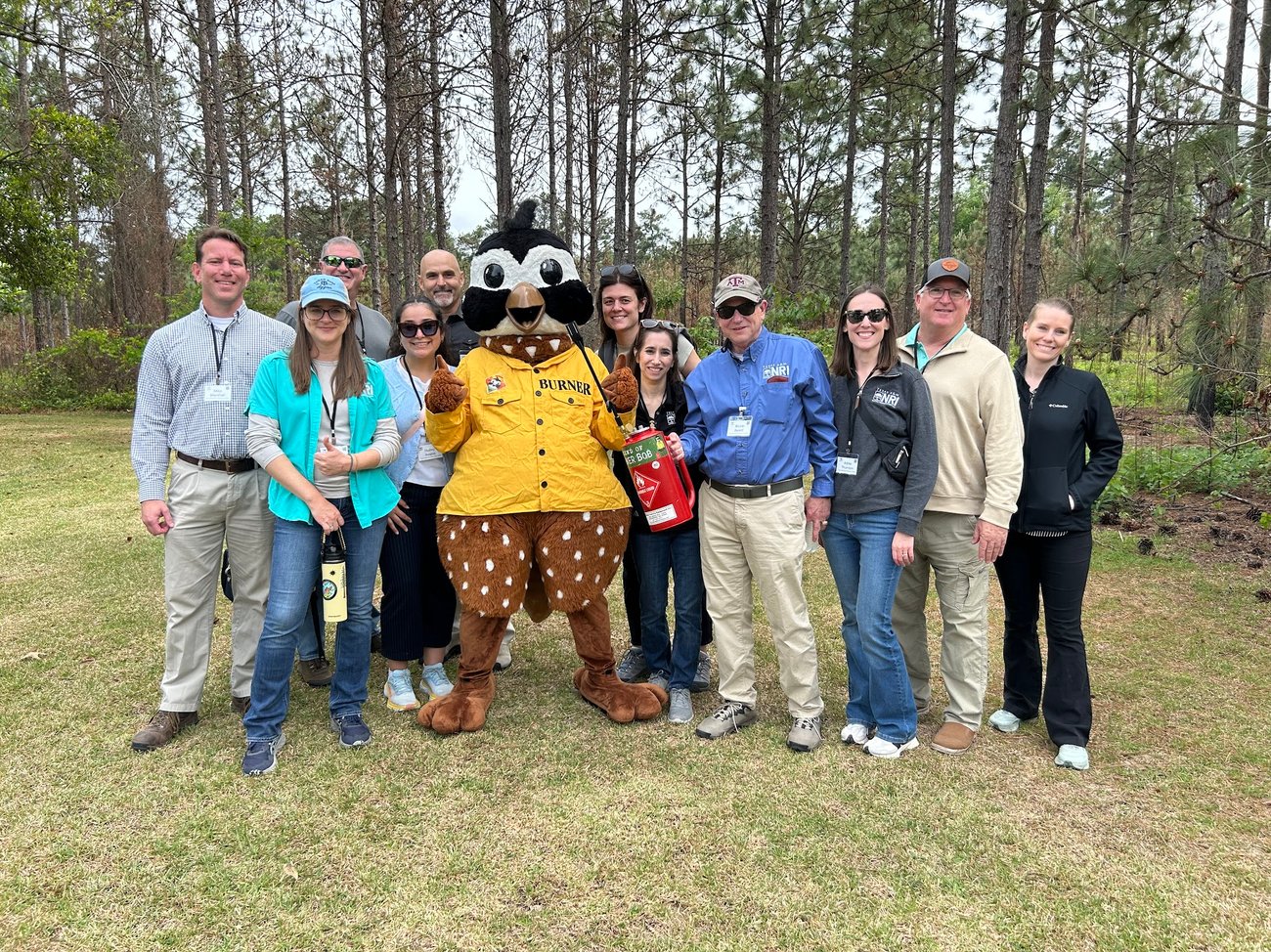
      A wide, eye-level outdoor group photograph of ten people standing on a grassy lawn alongside Burner Bob in front of a pine forest under an overcast sky.
      The 2026 Principals Meeting for the Southeastern Regional Partnership for Planning and Sustainability (SERPPAS) was recently held in Pinehurst, North Carolina. The meeting provided an opportunity to build relationships and reminisce on the last 20 years of the partnership. A major highlight of the meeting was the mobile meeting, where participants got to visit the Paint Hill Farm Tract of the Weymouth Woods Sandhills Nature Preserve and learn about the successes across partnerships with natural resources, red-cockaded woodpeckers, and  the military mission. Participants were also treated to a visit from Burner Bob!
           
          Southeast FireMap 2.0 is Now Available
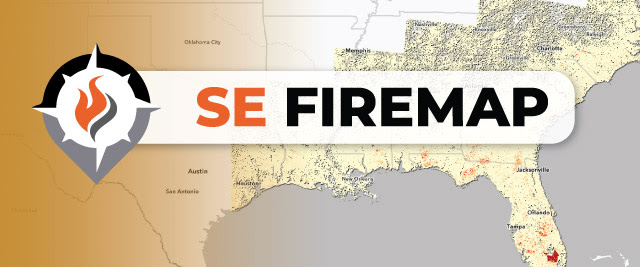
          The Southeast FireMap 2.0, developed in collaboration with Tall Timbers, USGS, The Longleaf Alliance, US Endowment for Forestry and Communities, Ferguson Lynch, and NRCS has been released. The goal of this map is to be a decision-support tool to help land managers and fire practitioners more accurately track fire patterns across the Southeast using 30 years of wildfire and prescribed fire data. The Southeast FireMap 2.0 now includes Downloadable Burn Reports and updated data through 2025. Practitioners can access the map online to utilize the new features and layers and download updated datasets.  
              A wide, eye-level photograph of a pine forest stand immediately following a prescribed fire, showing the stark contrast between the blackened ground and the surviving trees. The Forest Floor: The entire ground under the trees is charred and covered in a layer of black ash, soot, and burned pine needles. A few scattered, unburned green and yellow grass blades are starting to poke through the ash in the immediate foreground. The Trees: Dozens of tall, straight pine trees fill the frame, stretching deep into the background. The lower portions of their rough, textured bark are heavily charred and blackened from the heat of the surface fire, while the upper trunks retain their natural lighter, greyish-brown color. The Lighting: The scene is lit with flat, overcast daytime light, casting
very few shadows and highlighting the texture of the charred bark and forest floor.
               
              Lessons Learned from a Pre-Mixed Fuel Can Failure
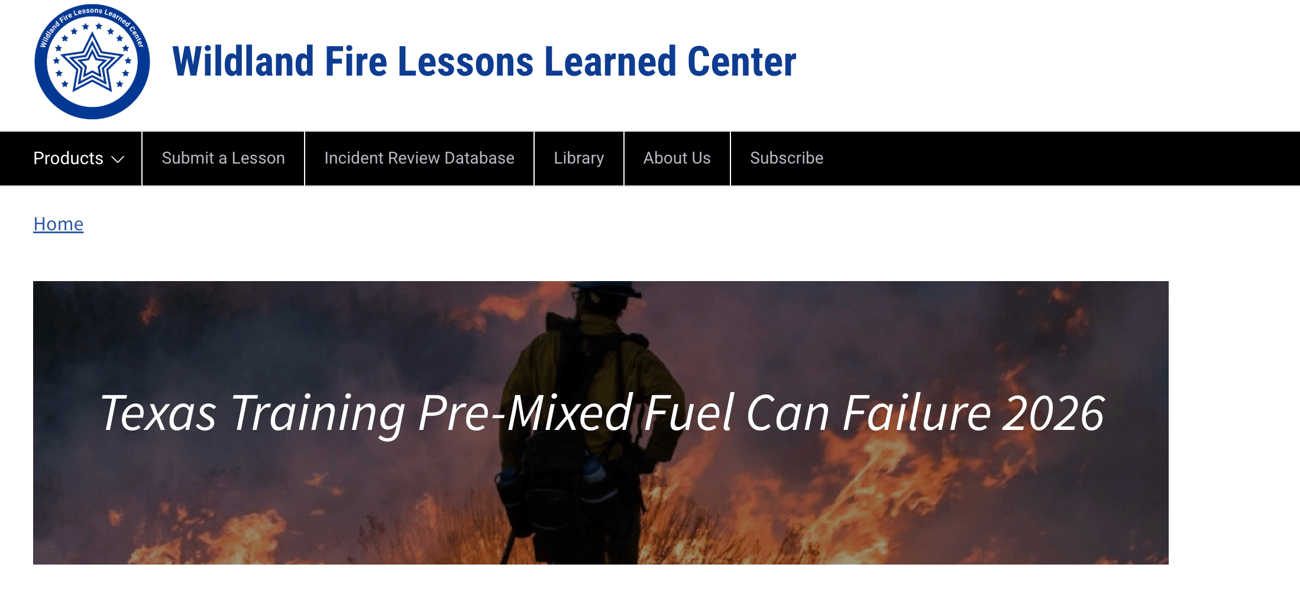
              A partial screenshot of the Wildland Fire Lessons Learned Center website homepage, featuring a prominent incident report banner. The Header: At the top left, a circular blue logo features a star surrounded by text that reads "Wildland Fire Lessons Learned Center." To the right of the logo, the center's name is written in bold blue text. Below this header is a black navigation bar with menu options including "Products," "Submit a Lesson," "Incident Review Database," "Library," "About Us," and "Subscribe." The Main Banner: Below a small "Home" breadcrumb link sits a wide, dark panoramic image showing a wildland firefighter viewed from behind, standing before an intense fire with bright orange flames and thick
smoke. Overlaid across the center of this image in large white italicized text is the title: "Texas Training Pre-Mixed Fuel Can Failure 2026."
              A new Rapid Lesson Sharing Report discusses a premixed fuel can failure during a chainsaw training in Texas. During the training, a crew experienced a fuel can failure when a can of pre-mixed fuel suddenly burst and popped off its plastic spout while in the bed of a pickup truck. Because the fuel can was properly stored inside a dedicated fuel bag, the liquid spray was successfully contained, though fuel still leaked into the truck bed. Lessons learned from the incident include the critical importance of utilizing secondary containment systems, like fuel bags, to mitigate chemical exposure and fire hazards when transporting volatile liquids.
                 
                Other Fire Highlights and News
                 
                New Science Suggests Relationship Between Prescribed Fire and Feral Hog Activity
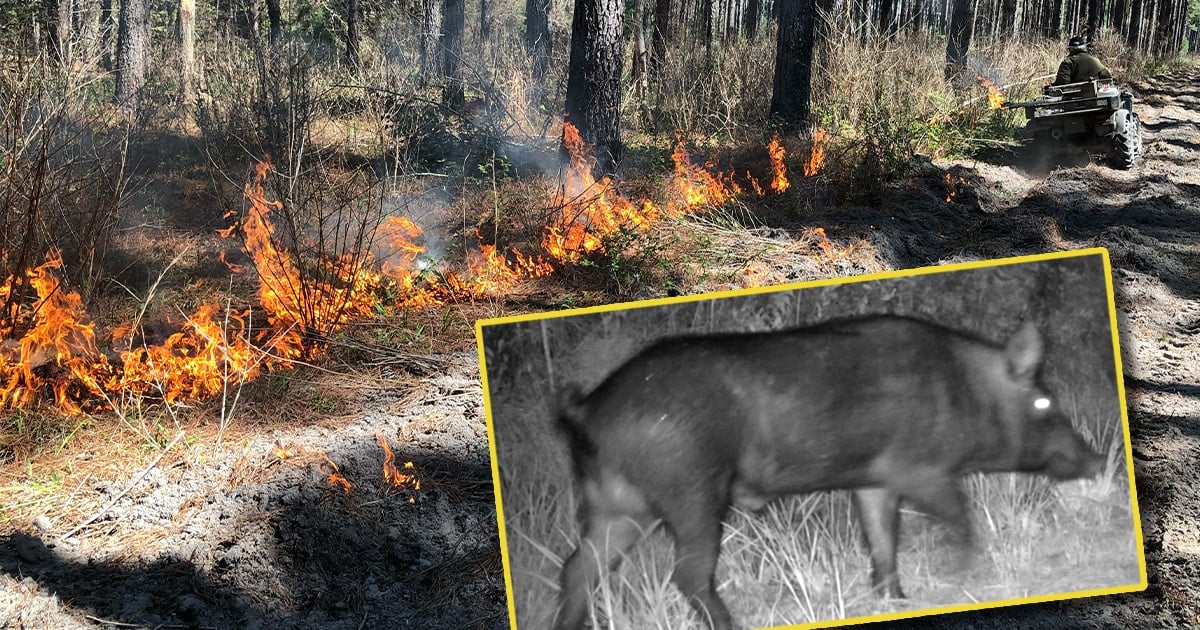
                A composite image showing a prescribed fire in progress with a trail camera photo of a feral hog superimposed in the foreground. The Background Scene: A person is driving an ATV away from the camera down a dirt track through a pine forest, igniting a prescribed fire along the edge of the woods. A line of low, bright orange flames burns through the dry ground cover and low brush beneath the tall pine trees. The Inset Image: In the bottom right corner, a rectangular, yellow-bordered inset shows a black-and-white trail camera photo of a large, dark feral hog walking through tall grass at night.
                New research from the University of Georgia and Tall Timbers suggest that prescribed fire is a powerful tool for controlling invasive feral hogs in the Southeast. By tracking wild pigs across 50,000 acres in South Georgia and North Florida, scientists discovered that feral hogs heavily prefer fire-suppressed areas with dense, unburned mid-story cover. Notably, feral hog activity spikes significantly once a site goes more than three years without a burn, suggesting that maintaining a frequent fire return interval could help reduce feral pig use of an area.
                   
                  New Factsheet on Using Targeted Grazing to Create Firebreaks
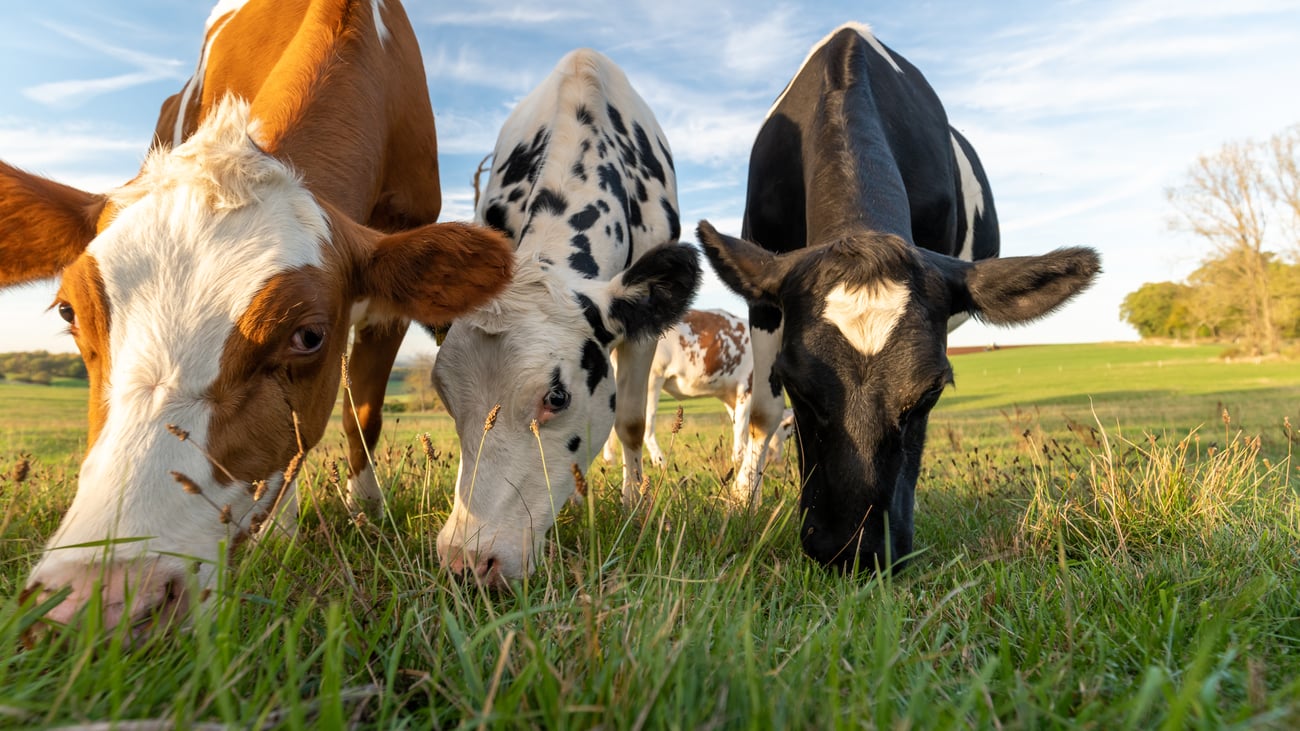
                  A new factsheet from the Texas A&M AgriLife Extension Service highlights how landowners can utilize livestock to strategically construct and maintain effective firebreaks. By implementing targeted grazing using different timing and livestock selection, managers can efficiently remove the fine, fast-burning fuels that typically drive intense wildfire spread. This ecological approach offers a highly cost-effective alternative to mechanical or chemical vegetation control while simultaneously enhancing soil health and land sustainability.
                  A low-angle, wide-shot photograph of three cows grazing side-by-side in a green pasture on a bright, sunny day. The Cows: In the foreground, three young cows lean their heads down toward the grass, facing forward. On the left is a brown and white cow, mostly showing its head and face in a close-up profile. In the middle is a white cow with black
spots. On the right is a black cow with a distinct white diamond-shaped patch on its forehead. Another brown and white cow is visible further back in the field behind them. The Setting: The cows are eating green grass and low weeds under a bright blue sky with light, wispy clouds. The late afternoon sun casts a warm, golden light on their faces. In the background, the pasture rolls gently upward toward a distant treeline on the right.
                   
                  El Niño and La Niña Provide Early Insights into Wildfire Severity
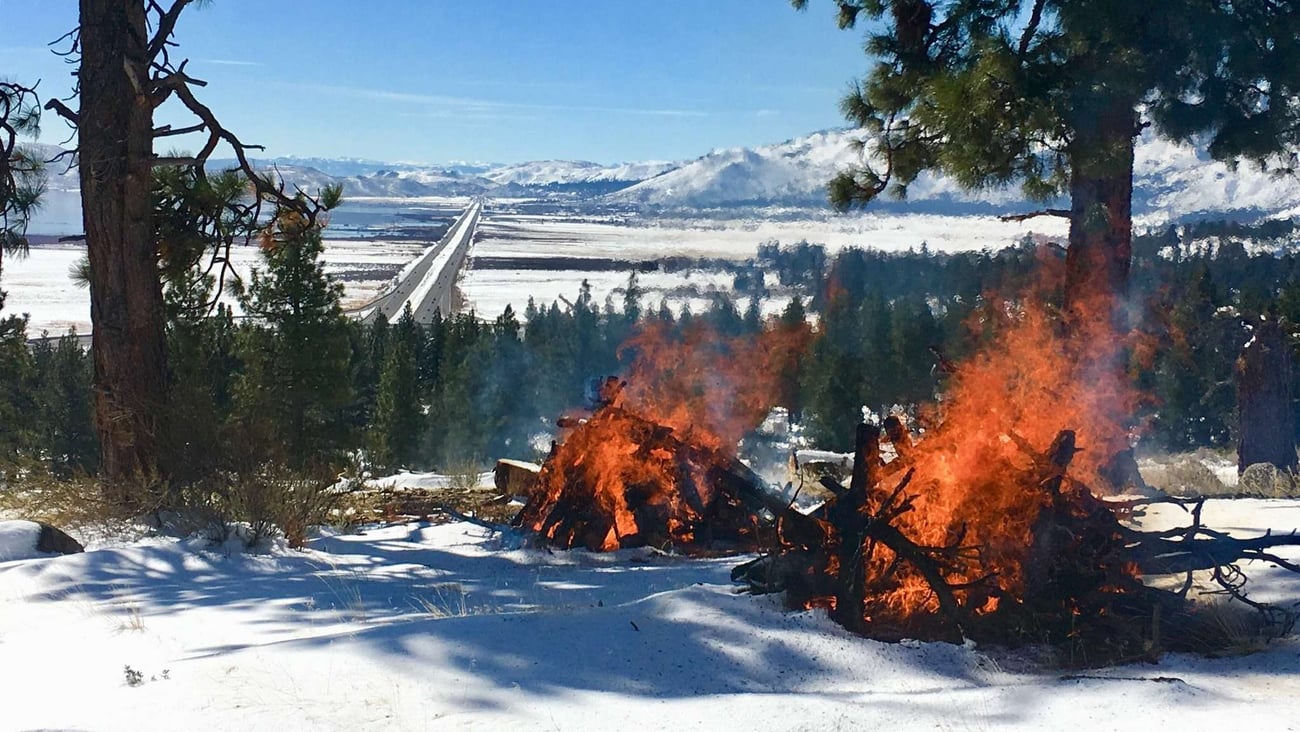
                  A scenic, high-angle landscape photograph showing active slash pile burning on a snowy hillside overlooking a vast mountain valley. The Foreground: On a snow-covered slope, two large piles of cut logs, branches, and woody debris are burning with bright orange and red flames. Light blue smoke rises from the fires. A few evergreen trees frame the left and right sides of the immediate foreground. The Background Landscape: Below the hillside, a dense green forest of pine trees leads down to a wide, flat valley floor blanketed in white snow. A long, straight multi-lane highway stretches directly through the center of the valley toward the horizon. The Horizon: In the far distance, a massive range of rolling mountains covered in snow sits under a clear, bright blue sky.
                  Recent research published by NOAA is a highly accurate predictor of U.S. wildfire severity up to a year in advance. By analyzing weather and burn records from 1984 to 2022, scientists found that an autumn La Niña phase consistently triggers dry winter and spring conditions, more than doubling the following year's fire risk across southern regions. Conversely, an autumn El Niño brings increased precipitation to the southern tier, effectively cutting the expected spring and summer burn areas in half. This predictive link provides a critical long-range tool for wildland fire managers to anticipate severe seasonal fire activity and allocate resources well ahead of time.

                     
                    Funding Resources
                     
                    The official logo for the Natural Resources Conservation Service (NRCS). It features a stylized blue water droplet cradled by a green semi-circle on the left, with the large blue letters "NRCS" and the full name "Natural Resources Conservation Service" written in black below.
                     
                    The official logo for the "Fire on the Forty" program, featuring wildlife silhouettes against a sunset background enclosed in a flame graphic. The Flame Emblem: The entire logo is shaped like a stylized, orange-and-red gas flame wrapping around a central circle. The main curve of the flame swoops up prominently at the top, with a smaller secondary flame point on the right. The Graphic Circle: Inside the circular portion of the emblem, a glossy sunset scene fades from a deep red at the top to a warm yellow at the bottom. Silhouetted in solid black against this sunset are a single tall pine tree on the left and a northern bobwhite quail standing on the ground to the right. The Text Banner: A horizontal, rounded rectangular banner with
an orange gradient stretches out from the right side of the circle. Inside the banner, the program's name, "Fire on the Forty," is written in a bold, black serif font. The entire logo is set against a solid black background.


                    • The Mississippi Department of Wildlife, Fisheries, and Parks is accepting applications through its Fire on the Forty program to support private landowners in implementing prescribed fire to improve wildlife habitat, enhance forest health, and reduce hazardous fuel loads on private lands across Mississippi.

                    Funding available for:

                      • Prescribed burn planning and implementation
                      • Firebreak establishment and maintenance

                    Application deadline: June 19, 2026
                    Job Opportunities
                     
                    Assistant Preserve Manager
                    • Celeste, TX
                    • The Nature Conservancy
                    • Open Until Filled


                    Conservation Coordinator
                    • Wilmington, NC
                    • The Nature Conservancy
                    • Open Until Filled


                    Prescribed Fire and Stewardship Technician
                    • Multiple Locations, KY
                    • The Nature Conservancy
                    • Open Until Filled


                    Part Time Natural Resources Assistant
                    (19 hr/week)

                    • Huntersville, NC (2 positions)
                    • Mecklenburg County Parks and Recreation
                    • Open Until Filled
                     
                     
                    Blacksburg Prescribed Fire and Fuels Crew Lead (SRB)
                    • Blacksburg, VA
                    • The Ember Alliance
                    • Open Until Filled
                     
                    Blacksburg Prescribed Fire and Fuels Crew Member (FFT1, FAL2)
                    • Blacksburg, VA
                    • The Ember Alliance
                    • Open Until Filled
                     
                    Call-When-Needed Wildland Fire Training Instructor
                    • Fort Collins, CO (Employees can work remotely)
                    • The Ember Alliance
                    • Open Until Filled
                     
                    Fuels Monitoring Module Crewmember
                    • Greenville, SC
                    • The Ember Alliance
                    • Open Until Filled
                     
                    Check out this useful Sparked Resources webpage for useful resources on fire career paths.
                    Check out this dedicated SAFE community Discord server to connect with students nationwide on fire ecology.
                    Check out this Association for Fire Ecology website for students studying fire.
                    Check out the FireUp job board, a job posting site for fire and forestry work.
                     
                    Upcoming Events
                     
                     
                    Fire Training Courses and Workshops


                    Self-Guided
                    Virtual
                     

                    Self- Guided
                    Virtual
                     
                    May 25-
                    June 12

                    Virtual


                    June
                    4-5
                    Jasper, GA
                     
                    June
                    11-12
                    Oakfield, GA
                     
                     
                    June
                    15-17
                    Gatesville, TX
                     
                     
                    June
                    20
                    Mebane, NC
                     
                     
                    August
                    2-8
                    Columbus, AR
                     
                    September
                    14-16
                    College Station, TX


                    Self-Guided
                    Virtual
                     
                    May 11
                    -June 4

                    Virtual with In-Person Field Days
                     
                    June
                    1-5
                    Augusta Springs, VA
                     
                     
                    June
                    8-11
                    Newland, NC
                     
                     
                    June
                    14-19
                    Newland, NC
                     
                     
                    June
                    16
                    Currie, NC
                     
                     
                    July
                    21-23
                    Virtual with In-Person Field Trips
                     
                    September
                    11-19
                    Pineville, KY
                     
                    October
                    12-14
                    Virtual with In-Person Field Days


                    Consult this SAWFIT website for a useful resource on other fire trainings offered across the Southeast.
                     
                    Webinars
                     
                    June
                    3
                    Virtual
                     
                    June
                    10
                    Virtual
                     
                    July
                    8
                    Virtual
                     
                    August
                    5
                    Virtual
                     
                    October
                    7
                    Virtual


                    June
                    8
                    Virtual
                     
                    June
                    24
                    Virtual
                     
                    July
                    28
                    Virtual
                     
                    September
                    14
                    Virtual


                    Conferences, Meetings, and Other Events
                     
                    June
                    2-4
                    Bloomington, IN
                     
                    August
                    4-6
                    Alva, OK
                     
                    October
                    27-30
                    Williamsburg, VA


                    June
                    6
                    Jasper, GA
                     
                    August
                    26-27
                    Nags Head, NC


                    Consult the Wildfire Conferences website for a useful resource on other fire conferences offered globally.

                    Subscribe to Wildfire Today, a wildfire news & opinion site.

                    Share your stories, events, and information in the next issue:

                    Sarah Cain: sacain2@ncsu.edu
                    Jennifer Fawcett: jennifer_fawcett@ncsu.edu

                    Facebook
                     
                    Instagram
                     
                    Website
                     
                    Email
                    The Driptorch Digest is distributed by NC State University as a project of the Southeast Regional Partnership for Planning and Sustainability (SERPPAS) Prescribed Fire Working Group.

                    NC State University promotes equal opportunity and prohibits discrimination and harassment based upon one’s race; color; religion (including belief and non-belief); sex, including but not limited to pregnancy, childbirth, or other related medical condition, parenting, and sexual harassment; sexual orientation; actual or perceived gender identity; age; national origin; disability; veteran status; or genetic information.

                    This newsletter is made possible through a grant from the National Fish and Wildlife Foundation, with support from the USDA Forest Service and the Department of Defense.