|
|
|
|
|
|
Alexander County Center Newsletter
|
|
|
|
|
|
|
|
|
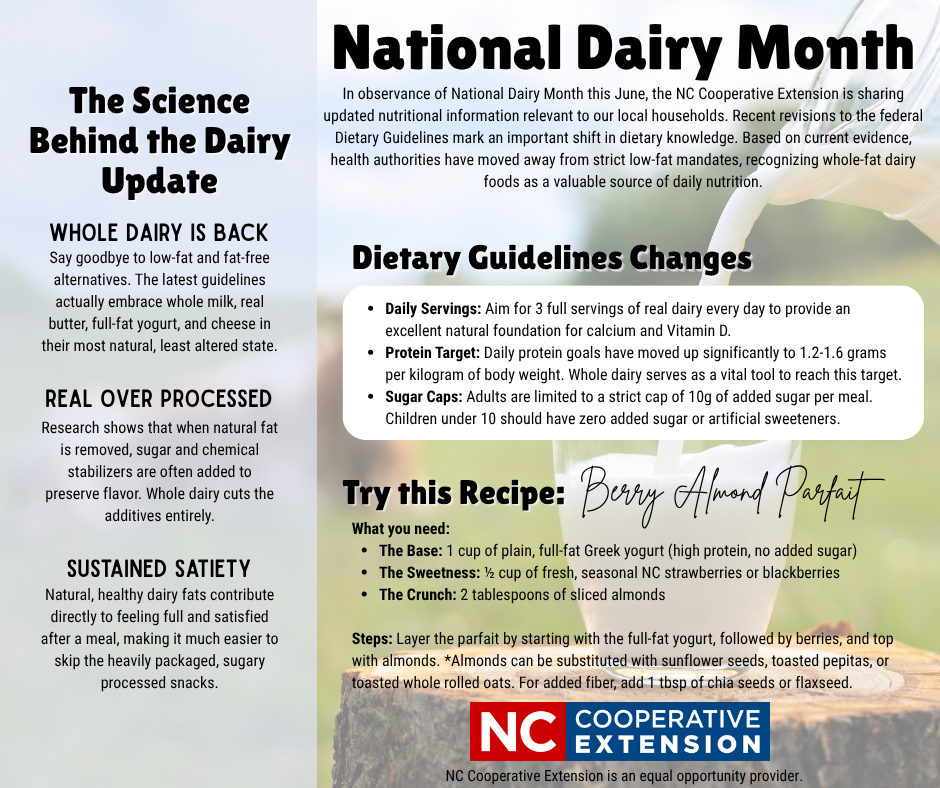
National Dairy Month
In observance of National Dairy Month this June, the NC Cooperative Extension is sharing updated nutritional information relevant to our local households. Recent revisions to the federal Dietary Guidelines mark an important shift in dietary knowledge. Based on current evidence, health authorities have moved away from strict low-fat mandates, recognizing whole-fat dairy foods as a valuable source of daily nutrition.
Topics covered:
The Science Behind the Dairy Updates
- Whole Dairy is back - Say goodbye to low-fat and fat-free alternatives. The latest
guidelines actually embrace whole milk, real butter, full-fat yogurt, and cheese in
their most natural, least altered state.
- Real Over Processed - Research shows that when natural fat is removed, sugar
and chemical stabilizers are often added to preserve flavor. Whole dairy cuts the
additives entirely.
- Sustained Satiety - Natural, healthy dairy fats contribute directly to feeling full and satisfied after a meal, making it much easier to skip the heavily packaged, sugary processed snacks.
Dietary Guidelines Changes
- Daily Servings: Aim for 3 full servings of real dairy every day to provide an
excellent natural foundation for calcium and Vitamin D.
- Protein Target: Daily protein goals have moved up significantly to 1.2-1.6 grams
per kilogram of body weight. Whole dairy serves as a vital tool to reach this
target.
- Sugar Caps: Adults are limited to a strict cap of 10g of added sugar per meal.
Children under 10 should have zero added sugar or artificial sweeteners.
Try this Recipe: Berry Almond Parfait
What you need:
- The Base: 1 cup of plain, full-fat Greek yogurt (high protein, no added
sugar)
- The Sweetness: ½ cup of fresh, seasonal NC strawberries or
blackberries
- The Crunch: 2 tablespoons of sliced almonds
Steps: Layer the parfait by starting with the full-fat yogurt, followed by berries,
and top with almonds. *Almonds can be substituted with sunflower seeds,
toasted pepitas, or toasted whole rolled oats. For added fiber, add 1 tbsp of chia
seeds or flaxseed.
|
|
|
|
|
Drought Assistance Available for Livestock Producers
The Livestock Forage Disaster Program (LFP), administered by the Farm Service Agency (FSA), provides financial support to livestock producers who experience grazing losses due to qualifying drought conditions. The program helps producers recover from significant forage losses and address increased feed costs resulting from disasters.
Farm records and acreage reports are required for LFP prior to completing the automated CCC-853 LFP application. Therefore producers should make sure all of their pastureland is registered with their local Farm Service Agency. Alexander County’s Farm Service Agency is located in Iredell County. Producers should contact FSA to make an appointment to update their records by calling 704-872-5061. All perennial forage acreage has to be reported by July 15, 2026 to the Farm Service Agency to be eligible to apply.
The application period for LFP will be open until March 2027, so you have plenty of time to apply. You may be asked to provide herd inventory records, vet records or some type of ownership verification.
Eligible grazing animals are both adult and weaned non-adult being produced or maintained for commercial use of the farming operation:
Beef and dairy cattle
Buffalo/beefalo/bison (including water buffalo)
Alpacas, deer, elk, emus, llamas, reindeer
Equine (horses are not eligible if produce for any reason other than commercial use)
Sheep, goats
Ostrich
The daily Animal Unit feed rate and monthly forage value determined according to 7 CFR 1416.207 is:
Year Daily AU Feed Rate Monthly Value of Forage for 1AU
2025 $1.3800 $41.40
2026 $1.1885 $35.66
|
|
|
|
|
|
|
|
|
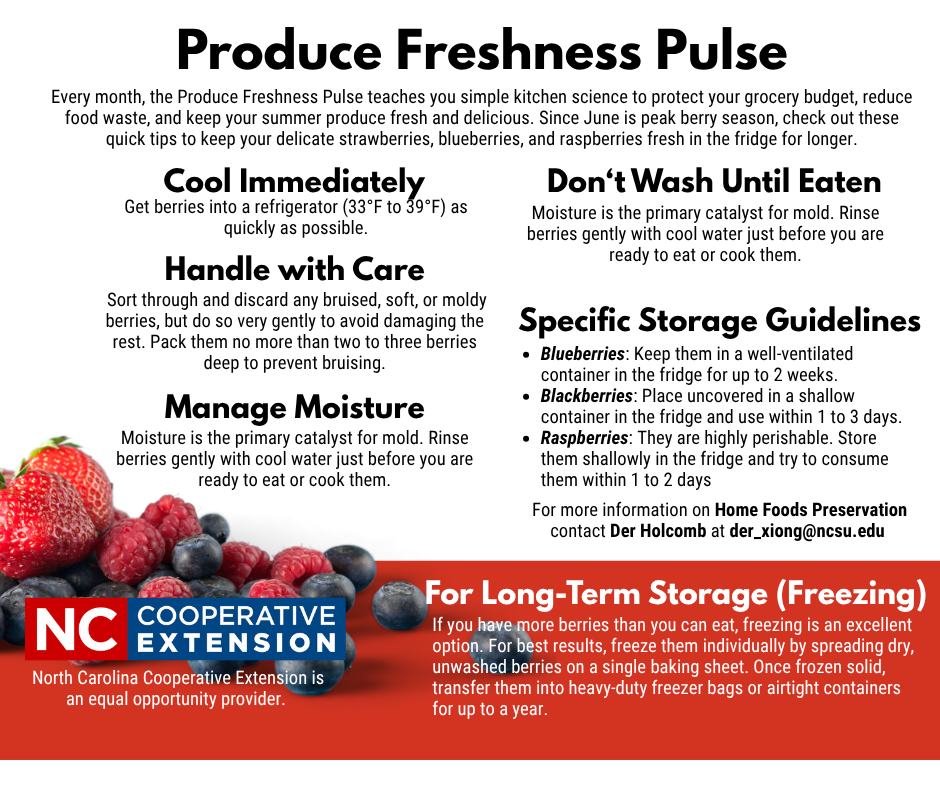
Produce Freshness Pulse
Every month, the Produce Freshness Pulse teaches you simple kitchen science
to protect your grocery budget, reduce food waste, and keep your summer produce fresh and delicious. Since June is peak berry season, check out these quick tips to keep your delicate strawberries, blueberries, and raspberries fresh in the fridge for longer.
Tips:
1. Cool Immediately: Get berries into a refrigerator (33°F to 39°F) as quickly as possible.
2. Handle with Care: Sort through and discard any bruised, soft, or moldy berries, but do so very gently to avoid damaging the rest. Pack them no more than two to three berries deep to prevent bruising.
3. Manage Moisture: Moisture is the primary catalyst for mold. Rinse berries gently with
cool water just before you are ready to eat or cook them.
4. Don’t wash until eaten: Moisture is the primary catalyst for mold. Rinse berries gently
with cool water just before you are ready to eat or cook them.
5. Specific Storage Guidelines
a. Blueberries: Keep them in a well-ventilated container in the fridge for up to 2
weeks.
b. Blackberries: Place uncovered in a shallow container in the fridge and use within 1 to 3 days.
c. Raspberries: They are highly perishable. Store them shallowly in the fridge and
try to consume them within 1 to 2 days
For Long-Term Storage (Freezing): If you have more berries than you can eat, freezing is an excellent option. For best results, freeze them individually by spreading dry, unwashed berries on a single baking sheet. Once frozen solid, transfer them into heavy-duty freezer bags or airtight containers for up to a year.
|
|
|
|
|
$10 a Meal Day
Quick, Easy, Affordable Recipes
Eating on a budget can be overwhelming, but it doesn’t mean that you will miss out on flavor. Try out this easy and affordable recipe, under $10 for a family of 4. Don’t forget to check out the QR code below for more recipes.
Recipe: One-Pan Cheesy Ground Turkey & Zucchini Rice Skillet
Cost: ~$10 for 4 serving
Ingredients list:
- 1 lb - ground turkey ($3.50)
- 2 - Zucchini and/or yellow squash ($1.50)
- 1.5 cup - brown rice (.60 cents)
- 1 cup - shredded cheddar cheese ($1.50)
- 1 carton - low sodium vegetable broth ($1.35)
- 1 - yellow onion, diced ($.55)
- 4 cloves - Garlic, minced ($.58)
- 1 tbsp Oil
- 1 tsp Salt
- ½ tsp pepper
- 1 tsp cumin or chili powder
Directions:
1. Prep the veggies - Dice onion, mince garlic, chop zucchini/squash into bite size half
moon piece)
2. Brown turkey and onion in 1 tablespoon oil, then stir in garlic, salt, pepper, and cumin.
3. Clear pan center, add 1.5 cups dry rice, and stir 2 minutes to toast.
4. Add 3 cups broth, bring to boil, cover, and simmer on low 12 minutes undisturbed.
5. Layer squash on top of rice, cover, and steam on low 5 minutes.
6. Stir everything, top with 1 cup cheddar, cover 2 minutes to melt, and serve.
|
|
|
|
|
New to Preservation?? Looking for Tested Recipes??
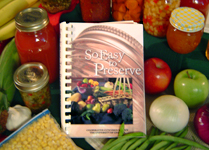
Whether you are freezing, drying or canning, it is always important to follow recipes that had been tested to ensure that it is safe to consume. Do not risk losing all your hard work due to spoilage. Known as the canning bible, So Easy to Preserve, 6th Edition, is a 375-page book with 185 tested recipes, along with step by step instructions and in depth infomration for both the new and experienced food preserver.
Pick up your copy today for $40.00-limited supply available.
For more information please contact Der Holcomb, Family and Consumer Extension Agent, by email: der_xiong@ncsu.edu or phone: 828-632-3125.
|
|
|
|
|
Green Thumb Gazette Newsletter
The June edition is now available. For more information on June and July garden tasks and what to be on the lookout for click the link below. This months newsletter also includes upcoming events along with several horticulture educational topics. If you find this newsletter helpful and you would like to receive it each month contact Cari Rosenbalm at cari_rosenbalm@ncsu.edu to be added to the mailing list.
|
|
|
|
|
|
|
Alexander 4-H Update
Alexander 4-H has been busy planning summer opportunities. We still have a few spots available in a few camps. For more information please click the newsletter link below.
Most of the 4-H Clubs take a summer break and regroup in August. We do have one that continues to meet, the 4-H Garden Club. If you have youth that are interested in horticulture this is a great group for them to join.
Click on the link below for more information and to view the full newsletter:
|
|
|
|
|
|
|
NC State University and N.C. A&T State University work in tandem, along with federal, state and local governments, to form a strategic partnership called N.C. Cooperative Extension.
|
|
|
|
|
|
|